Ying Li
Department of Radiation Oncology,Oncology Center, Zhujiang Hospital of Southern Medical University, No.253 Mid Gongye Ave, Haizhu District, Guangzhou, Guangdong Province, Postal code 510282, China.
Arzoo Prasai
Department of Radiation Oncology,Oncology Center, Zhujiang Hospital of Southern Medical University, No.253 Mid Gongye Ave, Haizhu District, Guangzhou, Guangdong Province, Postal code 510282, China.
Qianzi Kou
Department of Radiation Oncology,Oncology Center, Zhujiang Hospital of Southern Medical University, No.253 Mid Gongye Ave, Haizhu District, Guangzhou, Guangdong Province, Postal code 510282, China.
Virak Vicheth Virak
Department of Cardiology, Laboratory of Heart Center, Zhujiang Hospital, Southern Medical University, No. 253, Middle Gongye Avenue, Haizhu District, Guangzhou 510282, Guangdong, The People’s Republic of China
Sokhuon Cheat
Department of Radiation Oncology,Oncology Center, Zhujiang Hospital of Southern Medical University, No.253 Mid Gongye Ave, Haizhu District, Guangzhou, Guangdong Province, Postal code 510282, China.
Sokheng Phal
Department of Radiation Oncology,Oncology Center, Zhujiang Hospital of Southern Medical University, No.253 Mid Gongye Ave, Haizhu District, Guangzhou, Guangdong Province, Postal code 510282, China.
Nora Iv
Department of Radiation Oncology,Oncology Center, Zhujiang Hospital of Southern Medical University, No.253 Mid Gongye Ave, Haizhu District, Guangzhou, Guangdong Province, Postal code 510282, China.
Rattanaricky Ung
Department of Radiation Oncology,Oncology Center, Zhujiang Hospital of Southern Medical University, No.253 Mid Gongye Ave, Haizhu District, Guangzhou, Guangdong Province, Postal code 510282, China.
Gechhorng Lim
Department of Radiation Oncology,Oncology Center, Zhujiang Hospital of Southern Medical University, No.253 Mid Gongye Ave, Haizhu District, Guangzhou, Guangdong Province, Postal code 510282, China.
Vahid Say
School of International Education, Southern Medical University, Guangzhou, Guangdong Province 510515, China.
Ratanak Pich
School of International Education, Southern Medical University, Guangzhou, Guangdong Province 510515, China.
Seng An Hong
School of International Education, Southern Medical University, Guangzhou, Guangdong Province 510515, China.
Nita Nouth
School of International Education, Southern Medical University, Guangzhou, Guangdong Province 510515, China.
Dinarong Phan
School of International Education, Southern Medical University, Guangzhou, Guangdong Province 510515, China.
Pengkhun Nov
Department of Radiation Oncology,Oncology Center, Zhujiang Hospital of Southern Medical University, No.253 Mid Gongye Ave, Haizhu District, Guangzhou, Guangdong Province, Postal code 510282, China.";}
Juanli Xu
Department of Radiation Oncology,Oncology Center, Zhujiang Hospital of Southern Medical University, No.253 Mid Gongye Ave, Haizhu District, Guangzhou, Guangdong Province, Postal code 510282, China.
Jiqiang Li
Department of Radiation Oncology,Oncology Center, Zhujiang Hospital of Southern Medical University, No.253 Mid Gongye Ave, Haizhu District, Guangzhou, Guangdong Province, Postal code 510282, China.
Abstract
Abstract
Background: The relationship between circulating white blood cell (WBC) traits and colorectal cancer (CRC) risk remains unclear. This study employs Mendelian randomization (MR) to investigate whether genetic variants associated with WBC traits are causally linked to the development of CRC.
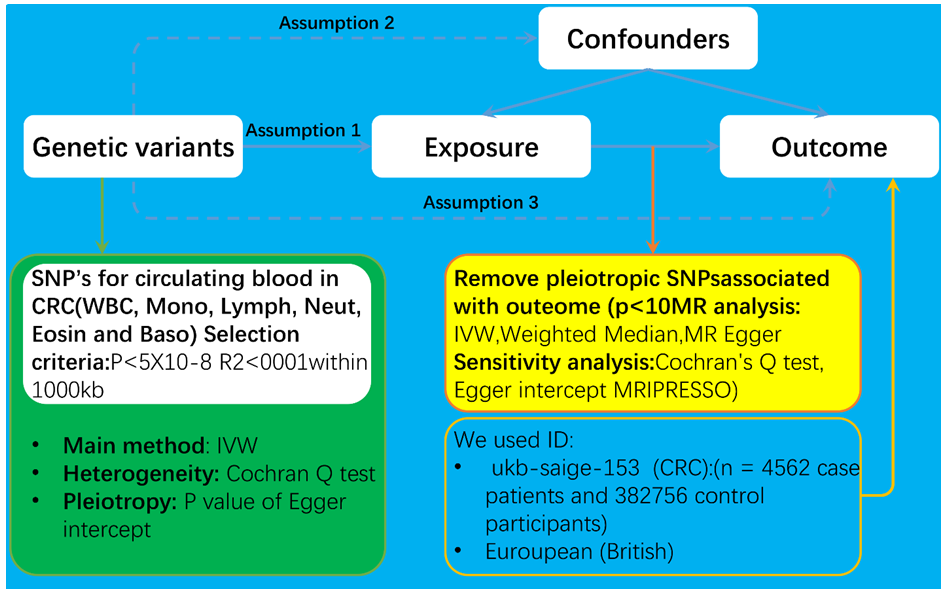
Methods: We utilized summary statistics from large-scale genome-wide association studies (GWAS) to identify single nucleotide polymorphisms (SNPs) associated with WBC traits, including total WBC count, neutrophils, lymphocytes, monocytes, and eosinophils. We then employed two-sample MR to assess the causal relationships between these WBC traits and CRC risk using publicly available GWAS data for CRC.
Results: Our analysis identified several SNPs significantly associated with WBC traits and CRC risk. The findings suggest a significant inverse causal relationship between colorectal cancer (CRC) and white blood cell count (Odds Ratio = 0.888, 95% Confidence Interval = 0.800 − 0.980, p = 0.026), as well as eosinophil count (Odds Ratio = 0.831, 95% Confidence Interval = 0.710 − 0.973, p = 0.022). However, no significant associations were seen between monocyte cell count, lymphocyte cell count, or neutrophil cell count and CRC.
Conclusion: This MR study suggests that higher circulating total white blood cell count and eosinophil count may be causally linked to decrease risk of colorectal cancer, highlighting the importance of immune regulation in cancer pathogenesis. Further investigations are warranted to elucidate the underlying mechanisms and assess the potential for WBC traits as biomarkers for CRC risk.