
Mendelian Randomization Analysis between micro RNA and Gastrointestinal Stromal Tumor
##plugins.themes.bootstrap3.article.sidebar##
##plugins.themes.bootstrap3.article.main##
Abstract
Abstract
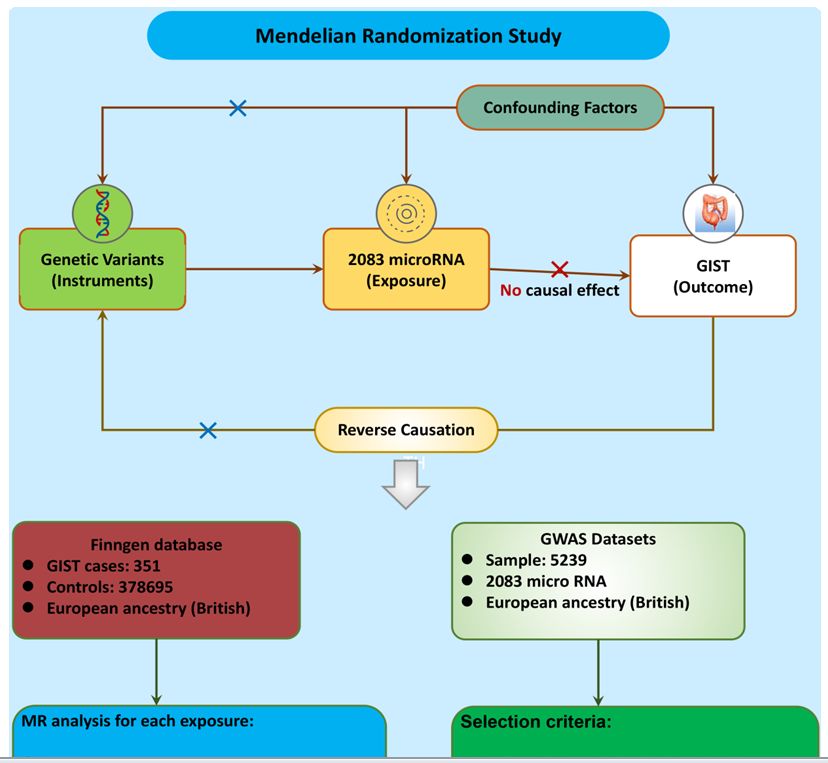
Background: MicroRNAs (miRNAs) are key regulators of gene expression and have been implicated in the pathogenesis of various cancers, including gastrointestinal stromal tumors (GISTs). However, the causal relationship between specific miRNAs and GIST risk remains uncertain. Mendelian Randomization (MR) offers a robust approach to infer causality by leveraging genetic variants as instrumental variables.
Methods: We conducted a two-sample MR analysis using summary statistics from genome-wide association studies (GWAS) of 2083 circulating miRNA levels and GIST susceptibility. Single nucleotide polymorphisms (SNPs) strongly associated with miRNA expression were selected as instrumental variables. The causal effect estimates were obtained using inverse-variance weighted (IVW) methods, complemented by sensitivity analyses including MR-Egger and weighted median approaches to assess for pleiotropy and robustness.
Results: Our results identified suggestive evidence for a causal relationship between specific 87 miRNAs and GIST risk. Notably, the GIST risk was strongly associated with miR-23a-3p [odds ratio (OR) = 6.379, 95% confidence interval (CI) = 1.080 – 37.659, p = 0.040], miR-20b-5p (OR = 5.666, 95% CI = 1.185– 27.083, p = 0.029), miR-608 (OR = 3.291, 95% CI = 1.530 – 7.078, p = 0.002), miR-125b-5p (OR = 2.450, 95% CI = 1.185–5.065, p = 0.015), miR-1322 (OR = 2.142, 95% CI = 1.235–3.713, p = 0.006), and miR-939-5p (OR = 1.864, 95% CI = 1.260–2.759, p = 0.001).
Conclusions: This MR study provides preliminary evidence supporting a potential causal role of certain miRNAs in GIST development. These findings could inform future functional studies and highlight miRNAs as potential biomarkers or therapeutic targets in GIST management. Further research with larger GWAS datasets is warranted to validate these associations.