Vicheth Virak
Department of Cardiovascular disease, Preah Ket Mealea Hospital, Rue de France (st.47), 12203 Phnom Penh, Cambodia
Panhaleap Meas
Department of Cardiology, Laboratory of Heart Center, Zhujiang Hospital of Southern Medical University, No.253 Mid Gongye Ave, Haizhu District, Guangzhou, Guangdong Province, Postal code 510282, China
Vanna Hen
Department of Cardiovascular disease, Preah Ket Mealea Hospital, Rue de France (st.47), 12203 Phnom Penh, Cambodia
Pengkhun Nov
Department of Radiation Oncology,Oncology Center, Zhujiang Hospital of Southern Medical University, No.253 Mid Gongye Ave, Haizhu District, Guangzhou, Guangdong Province, Postal code 510282, China
Sokheng Phal
Department of Cardiology, Laboratory of Heart Center, Zhujiang Hospital of Southern Medical University, No.253 Mid Gongye Ave, Haizhu District, Guangzhou, Guangdong Province, Postal code 510282, China
Ngare Nadjingar
Department of Cardiology, Laboratory of Heart Center, Zhujiang Hospital of Southern Medical University, No.253 Mid Gongye Ave, Haizhu District, Guangzhou, Guangdong Province, Postal code 510282, China
Vahid Say
Department of Cardiology, Laboratory of Heart Center, Zhujiang Hospital of Southern Medical University, No.253 Mid Gongye Ave, Haizhu District, Guangzhou, Guangdong Province, Postal code 510282, China
Sokhuon Cheat
Department of Cardiology, Laboratory of Heart Center, Zhujiang Hospital of Southern Medical University, No.253 Mid Gongye Ave, Haizhu District, Guangzhou, Guangdong Province, Postal code 510282, China
Rattanaricky Ung
epartment of Radiation Oncology,Oncology Center, Zhujiang Hospital of Southern Medical University, No.253 Mid Gongye Ave, Haizhu District, Guangzhou, Guangdong Province, Postal code 510282, China
Nora Iv
epartment of Radiation Oncology,Oncology Center, Zhujiang Hospital of Southern Medical University, No.253 Mid Gongye Ave, Haizhu District, Guangzhou, Guangdong Province, Postal code 510282, China
Ratanak Pich
Department of Radiation Oncology,Oncology Center, Zhujiang Hospital of Southern Medical University, No.253 Mid Gongye Ave, Haizhu District, Guangzhou, Guangdong Province, Postal code 510282, China
Dinarong Phan
Department of Radiation Oncology,Oncology Center, Zhujiang Hospital of Southern Medical University, No.253 Mid Gongye Ave, Haizhu District, Guangzhou, Guangdong Province, Postal code 510282, China
Sothearith Pich
Department of Cardiology, Laboratory of Heart Center, Zhujiang Hospital of Southern Medical University, No.253 Mid Gongye Ave, Haizhu District, Guangzhou, Guangdong Province, Postal code 510282, China
Sereyvathana Kong
Department of Cardiology, Laboratory of Heart Center, Zhujiang Hospital of Southern Medical University, No.253 Mid Gongye Ave, Haizhu District, Guangzhou, Guangdong Province, Postal code 510282, China
Abstract
Abstract
Introduction: Arrhythmias, characterized by abnormal heart rhythms, are a significant public health concern. The relationship between circulating metabolic biomarkers and arrhythmia development is actively investigated. Mendelian randomization (MR) offers insight into causal links between metabolic biomarkers and disease outcomes.
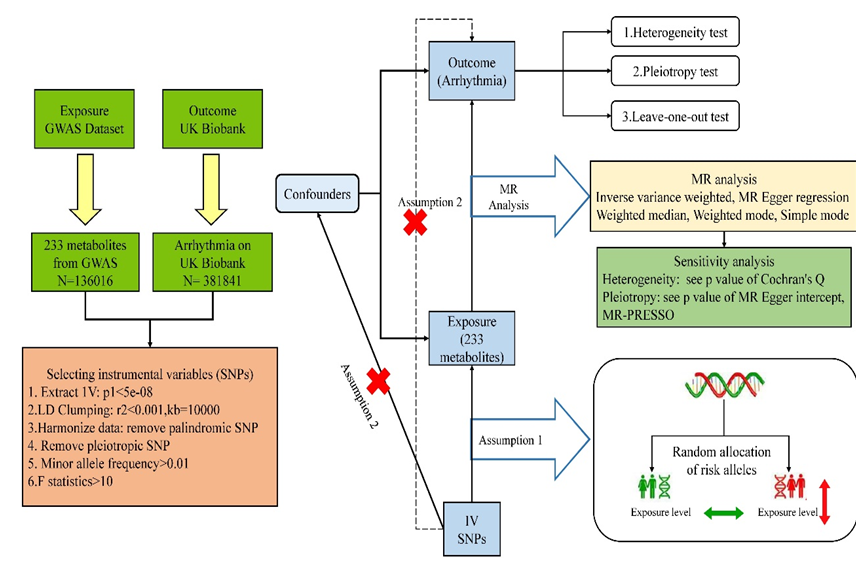
Methods: In this two-sample MR study, we used data from the NHGRI-EBI GWAS Catalog and UK Biobank to explore causal relationships between metabolic biomarkers and arrhythmia risk. Rigorous criteria selected genetic instrumental variables and MR methods like inverse variance weighting were applied.
Results: Our analysis identified three metabolic biomarkers associated with increased arrhythmia risk: creatinine, tyrosine, and the phospholipids to total lipids ratio in very large HDL. These findings suggest specific metabolic disturbances may contribute to arrhythmia development.
Conclusion: This MR study reveals insights into the links between metabolic biomarkers and arrhythmia risk. These associations suggest metabolic factors play a role in arrhythmia pathogenesis, offering opportunities for targeted interventions and personalized treatments. Further research is needed to understand mechanisms and clinical implications.