
The Causal Relationship Between Circulating Metabolic Biomarkers and Gastric Cancer: A Mendelian Randomization Study
##plugins.themes.bootstrap3.article.sidebar##
##plugins.themes.bootstrap3.article.main##
Abstract
abstract
BACKGROUND:Gastric cancer (GC) is a major global health problem, and understanding its causes is critical to developing effective prevention strategies. Metabolites may play an important role in cancer development as key intermediates in metabolic pathways. This study employed a Mendelian randomization approach to explore the causal relationship between circulating metabolic biomarkers and gastric cancer risk.
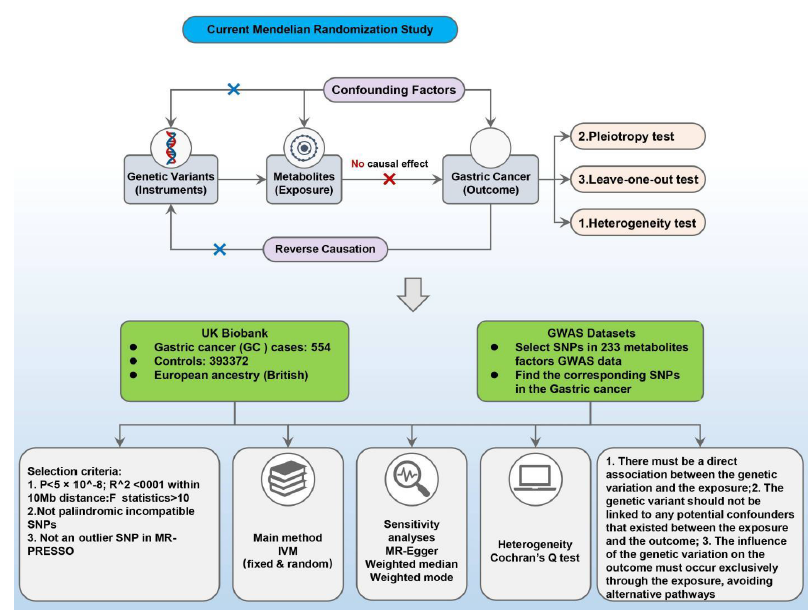
METHODS:An extensive two-sample MR analysis was included in this study. Briefly, publicly available genetic data were used to investigate causal relationships between 1400 metabolites and GC; MR analysis was performed using an inverse variance-weighted (IVW) model and a weighted median; Heterogeneity and pleiotropy were assessed using sensitivity analysis.
Results: Our analysis revealed a total of 49 circulating metabolic biomarkers associated with GC. Among them, the ratio of cholesteryl esters to total lipids in large HDL [odds ratio (OR) = 1.850, 95% confidence interval (CI) = 1.264– 2.709, P adjusted (P_FDR) = 0.010], the ratio of free cholesterol to total lipid in intermediate LDL (OR = 1.621, 95% CI=1.222–2.150, P_FDR = 0.008), and the ratio of phospholipids to total lipid in intermediate LDL (OR = 1.556, 95% CI = 1.193–2.030, P). _FDR= 0.008), total cholesterol levels in small HDL (OR = 0.472, 95% CI= 0.302 – 0.739, P_FDR= 0.008), cholesteryl esters in small HDL (OR = 0.574, 95% CI= 0.391 – 0.843, P_FDR= 0.024), and phospholipid to total lipid ratio in large HDL (OR = 0.580, 95% CI = 0.416 – 0.809, P_FDR=). 0.009) is closely related to GC. Of note, the ratio of cholesteryl esters to total lipids in large HDL, free cholesterol to total lipid ratio in moderate LDL, and phospholipid to total lipid ratio in moderate LDL were associated with increased risk factors for SC, whereas total cholesterol levels in small HDL, phospholipid to total lipid ratio in large HDL, cholesteryl esters in small HDL, and phospholipid to total lipid ratio in large HDL were protective factors for GC.
Conclusion: This study provides evidence for the causal relationship between circulating metabolism biomarkers and gastric cancer, and emphasizes the importance of metabolic factors in the etiology of cancer. Our findings contribute to the understanding of gastric cancer mechanisms and may inform research into future prevention and treatment strategies. Further research is needed to validate these associations and explore the underlying biological mechanisms.