
Global and China Data on the Burden of Liver Cancer Due to Hepatitis B From 1990 to 2021: A Systematic Analysis from the Global Burden of Disease Study 2021
##plugins.themes.bootstrap3.article.sidebar##
##plugins.themes.bootstrap3.article.main##
Abstract
Background: Hepatocellular carcinoma (HCC) is one of the most common gastrointestinal tumors. Hepatitis B virus (HBV) is a major risk factor for hepatocellular carcinoma, and the burden of disease of hepatocellular carcinoma caused by HBV(LCHB) has changed significantly over the past decades. Therefore, the present study analyzed the latest data on LCHB from 1990 to 2021 to identify patterns of HCC incidence, prevalence, and mortality as well as change trends at the age, sex, and socio-demographic index (SDI) levels, and to predict the changing trends of the disease from 2022 to 2050.
Methods: First, the number of incidence, prevalence, deaths, and disability-adjusted life years (DALYs) and the corresponding age-standardized rates (ASRs) were assessed globally and in China in 2021 by different strata to describe the trends from 1990 to 2021. Temporal trends of disease burden from 1990 - 2021 were analyzed by linear regression models. Cluster analysis was used to assess the changing patterns of disease burden associated with the Global Burden of Disease Study (GBD) regions. Finally, ARIMA modeling was used to predict the burden of disease for the next 30 years. Furthermore, we performed frontier and correlation analysis as well as risk factors of the LCHB.
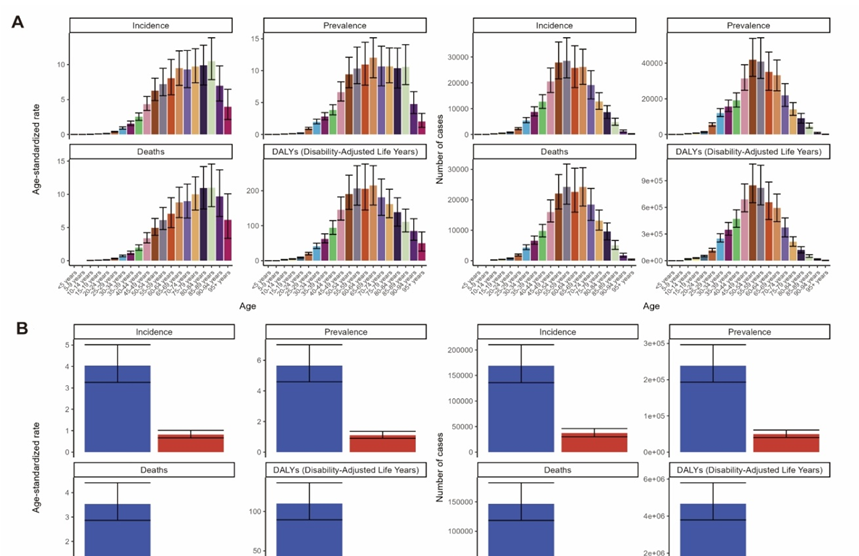
Results: In 2021, the global prevalence of LCHB was 206,366 and the number of deaths was 181,194, representing an increase in prevalence and deaths of 188% and 170%, respectively, compared with 1990. It is noteworthy that the corresponding ASRs of incidence, deaths and DALYs showed an overall decreasing trend, but the ASRs of prevalent showed an increasing trend. Compared to other age groups, the largest increases in ASRs of incidence (estimate annual percentage change (EAPC): 2.94 (2.73-3.15)), mortality (EAPC: 2.78 (2.56-3)) and DALYs (EAPC: 2.72 (2.49-2.95)) were observed in the >95 years age group. Men were at high risk and had a much higher burden of disease than women. Middle SDI regions had the highest disease burden, and age-standardised prevalence rates tended to increase in medium-high and high SDI regions. The disease burden of LCHB varied considerably between GBD regions and countries, with Asia having the highest disease burden of LCHB and Oceania having the lowest. In terms of ASR, East Asia ranked first and southern Latin America ranked last. The pattern of disease change in China is largely consistent with the global pattern of change, with age-standardised prevalence rates, mortality rates and rates of DALYs steadily declining in both men and women, despite the fact that the burden is currently higher in men. In addition, projections show that the number of incidence cases, prevalence cases, deaths, and DALYs cases in both men and women will continue to increase globally and in China from 2022 to 2050, with corresponding stabilisation of ASRs. Frontier analyses suggest that countries or regions with lower SDIs have less potential for burden improvement. Analyses of other risk factors for HCC suggest that smoking remains a major influence on HCC deaths globally, in China, and in Cambodia, albeit with a downward trend in its share. In contrast, the impact of high body mass index(BMI) on HCC has gradually increased.
Conclusion: LCHB remains an important public health problem globally, and although control of anti-HBV infection has led to a decrease in ASRs, we found that the number of cases of incidence, prevalence, deaths, and cases of DALYs are still increasing, and are expected to continue to do so. In addition, unfavorable trends in countries with high SDI and in the elderly suggest that existing prevention strategies may not apply to the changed forms of the disease burden and that more targeted and specific preventive and curative measures for different populations are warranted in some countries to prevent the increase in LCHB.