
Evolution of Pore Structure and Its Impact on Adsorption Performance of Coal Gangue Before and After CO₂-Water-Rock Interaction
##plugins.themes.bootstrap3.article.sidebar##
##plugins.themes.bootstrap3.article.main##
Abstract
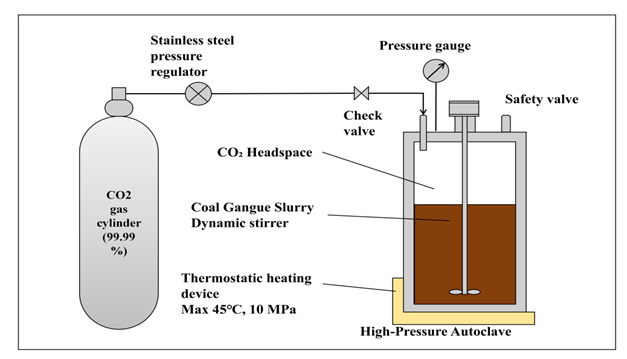
CO₂ geological sequestration using coal gangue backfilled in mined-out areas represents a crucial pathway for achieving synergistic pollution and carbon reduction. However, the dynamic modification mechanisms of complex CO₂-water-rock interactions on the pore structure of coal gangue, as well as their subsequent impacts on carbon sequestration potential, remain poorly understood. In this study, coal gangue with different initial occurrence states (crushed bulk rock and native dust) was investigated using a customized high-temperature and high-pressure dynamic reaction system to simulate the geological environment of mined-out areas (45 °C, 10 MPa). By integrating low-temperature N2 and isothermal CO₂ adsorption characterizations—combined with BET, BJH, DFT, and D-R/D-A models—the cross-scale evolution characteristics of mesopores and micropores before and after the reaction were systematically and quantitatively analyzed. The results indicate that: (1) The pore evolution pathways exhibit a strong initial-state dependency. Crushed bulk gangue generated a significant number of secondary micropores and broadened the mesopore throats, whereas the native gangue dust underwent severe physical clogging due to micropore collapse and precipitate migration. (2) The reconstruction of the micropore structure directly governs the maximum adsorption capacity. Quantitative analysis using the D-R model revealed that the reaction triggered a breakthrough 46.4% leap in the ultimate micropore volume ( V 0 ) for the OXC-1 sample (reaching 7.382 cm³/g), whereas the clogging effect led to an irreversible attenuation of V 0 for the FC-1 sample. (3) Macroscopic carbon sequestration performance is controlled by a cross-scale synergistic mechanism involving mesopore mass transfer and micropore storage ; enhancing pore throat connectivity and increasing adsorption sites are essential prerequisites for improving adsorption performance. This study reveals the laws of pore reconstruction and evolution under gas-water-rock interactions in porous media, providing a theoretical foundation for site selection assessment and safety prediction for CO₂ geological sequestration in coal mine goafs.