
Integrated Bioinformatic Analysis Identifies S100A8/A9 as Novel Mediators Linking Vascular Endothelial Pyroptosis to Immune Dysregulation in Diabetic Foot Ulcer
##plugins.themes.bootstrap3.article.sidebar##
##plugins.themes.bootstrap3.article.main##
Abstract
Background
Diabetic foot ulcers (DFU) are a severe diabetic complication marked by impaired healing, chronic inflammation, and microvascular dysfunction. Although vascular endothelial cell dysfunction and pyroptosis are implicated in DFU, the key molecular regulators connecting these pathological processes remain elusive.
Methods
An integrative bioinformatic analysis was conducted to identify key drivers. Differentially expressed genes (DEGs) from the DFU dataset GSE80178 were intersected with vascular endothelium and endothelial pyroptosis-related genes from GeneCards. Functional enrichment (GO/KEGG) of the resulting key genes was performed. Expression validation used GSE80178 and an independent dataset (GSE68183). Immune infiltration analysis (CIBERSORT) and upstream transcription factor screening (ChIP-Atlas) were also carried out.
Results
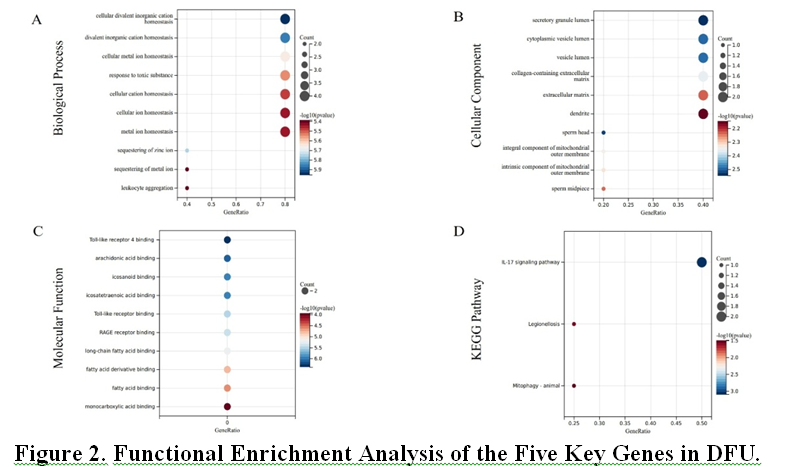
Five core genes (S100A9, S100A8, BNIP3, FSTL1, TACR1) were identified. They were enriched in IL-17 signaling, Legionellosis (involving NLRC4 inflammasome), and Mitophagy. S100A8 and S100A9 were consistently the most upregulated genes in DFU across datasets. Their high expression strongly correlated with a pro-inflammatory immune microenvironment, showing positive associations with monocytes and M0 macrophages, and negative correlations with resting NK and dendritic cells. Furthermore, the transcription factor DUX4 was identified as a potential upstream regulator of S100A9.
Conclusion
This study establishes S100A8 and S100A9 as central hubs in DFU, linking vascular dysfunction and pyroptosis to a sustained pro-inflammatory immune response. The novel identification of DUX4 as an upstream regulator provides deeper mechanistic insight, positioning the S100A8/A9 axis as a promising therapeutic target for breaking the chronic inflammatory cycle in DFU.