
An QRHKT:An Enhanced Question Representation and Historical Performance Fusion model for Knowledge Tracing
##plugins.themes.bootstrap3.article.sidebar##
##plugins.themes.bootstrap3.article.main##
Abstract
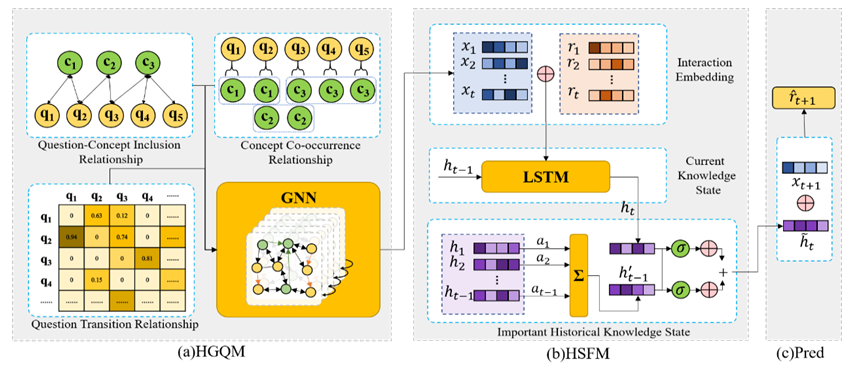
Knowledge tracing models student exercise records to dynamically assess their knowledge levels, providing targeted guidance for education and learning. Existing knowledge tracing models lack the utilization of global information in question representation and have not overcome the issue of long-term dependency on the sequence of student responses. To address these issues, we propose an Enhanced Question Representation and Historical Performance Fusion Knowledge Tracing model (QRHKT). First, we construct a heterogeneous graph structure by combining the inclusion relations between questions and concepts, transition relations between questions, and co-occurrence relations between concepts, and enhance question representations through graph neural network algorithms. To address the long-term dependency issue, we categorize the knowledge states into current knowledge states and historically important knowledge states from the perspective of the importance of a student’s historical knowledge state. The current knowledge state is obtained through a long short-term memory network, and historically important knowledge states are generated by weighted aggregation based on importance coefficients. Finally, by integrating these two types of knowledge states with question representation, we predict the student’s answering performance. Experimental results show that our proposed QRHKT achieves better knowledge tracing results on three public datasets.