
Single Cell Sequencing Dissection of Cellular and Regulatory Networks Driving Arteriovenous Fistula Aneurysmal Dilatation in Hemodialysis
##plugins.themes.bootstrap3.article.sidebar##
##plugins.themes.bootstrap3.article.main##
 https://orcid.org/0009-0008-4192-1160
Michael Keese
https://orcid.org/0000-0001-7787-3131
Yu Zhao
Yun Wang
https://orcid.org/0000-0001-5290-4253
Qining Fu
https://orcid.org/0000-0002-5205-2908
https://orcid.org/0009-0008-4192-1160
Michael Keese
https://orcid.org/0000-0001-7787-3131
Yu Zhao
Yun Wang
https://orcid.org/0000-0001-5290-4253
Qining Fu
https://orcid.org/0000-0002-5205-2908
Abstract
Abstract
Background Arteriovenous fistula aneurysmal dilatation (AVFAD) is a potentially fatal vascular complication in end-stage renal disease (ESRD) patients undergoing hemodialysis, yet its pathogenic mechanisms remain poorly understood.
Methods To explore the mechanisms, we applied single-cell RNA sequencing to venous tissues from a Type 1a AVFAD patient (N=1) and a control cephalic vein (N=1) to elucidate pathogenic drivers. In this study, we performed subpopulation composition analysis, pseudotime trajectory analysis, CellChat-based intercellular communication analysis, and transcription factor regulon analysis.
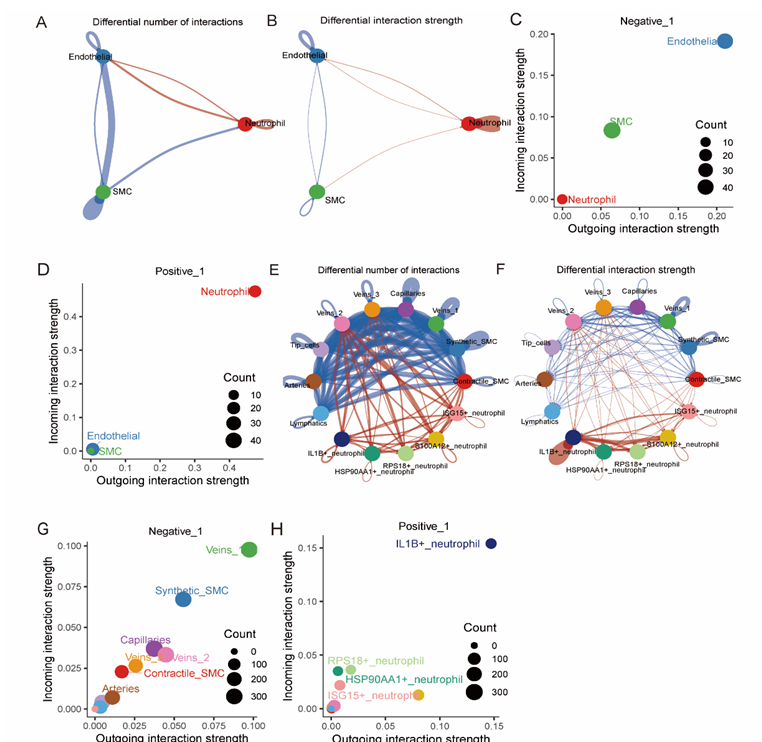
Results Venous endothelial cells (ECs), smooth muscle cells (SMCs), and neutrophils were examined, indicating ECs dysfunction, synthetic SMCs loss and neutrophils infiltration. Pseudotime analysis revealed dynamic transitions within vascular and immune cell populations. ECs were found to progress from vein 1 and capillaries phenotypes toward lymphatics and arteries. SMCs exhibited a switch from synthetic to contractile phenotype. Additionally, neutrophils transitioned from progenitor subsets marked by HSP90AA1⁺, IL1B⁺, and ISG15⁺ expression to terminally differentiated populations characterized by RPS18⁺ and S100A12⁺ signatures. CellChat analysis uncovered rewiring of ligand-receptor circuits: vein 2/3 subsets in ECs and contractile subset in SMCs dysregulated MTRNR2-FPR2, PECAM1-PECAM1 and ANXA1-FPR1/2 axes to drive neutrophil subsets, while neutrophil autocrine loops (CXCL8-CXCR2, CD55-ADGRE5, and PECAM1-PECAM1) sustained inflammation. High‑resolution regulon profiling pinpointed master transcription factors (GATA6+, ZNF76+ in ECs; ZFHX3+, PRDM16+ in SMCs; MBD4+, ZEB1+, KLF16+ in neutrophils) that aligned with these intercellular signals.
Conclusions Our findings suggest that a neutrophil-vascular axis may drive AVFAD through dynamic cellular reprogramming, offering novel therapeutic targets to mitigate vascular remodeling in hemodialysis patients.