
Effects of a Six-Week Plyometric Training Program on Speed, Strength, and Balance ability on Hard and Soft Surfaces in Adolescent Female Basketball Players
##plugins.themes.bootstrap3.article.sidebar##
##plugins.themes.bootstrap3.article.main##
Abstract
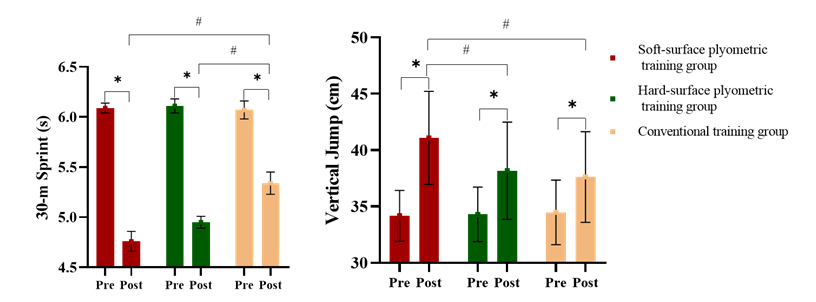
This study investigated the effects of 6 weeks of plyometric training (PT) performed on soft (unstable) and hard (stable) surfaces compared with conventional training on the balance, explosive power, and muscle strength of adolescent female basketball players. The participants were randomly assigned to three groups: soft-surface PT (n = 14), hard-surface PT (n = 14), and conventional training (n = 14). Performance outcomes included 30 m sprint time, vertical jump height, plantar flexion and dorsiflexion maximal voluntary isometric contraction (MVIC) torque, Y-balance dynamic balance, and center of pressure-based static balance. Ground reaction forces, MVIC torques, and balance parameters were measured using high-precision force sensors to ensure accurate quantification of biomechanical performance. Statistical analyses were performed using two-way repeated-measures ANOVA with post-hoc comparisons to evaluate group × time interaction effects across all outcome variables. Results demonstrated that soft- and hard-surface PT significantly improved sprint performance, vertical jump height, and plantar flexion MVIC torque compared with conventional training, while dorsiflexion MVIC increased similarly across all the groups. Notably, soft-surface training elicited greater enhancements in vertical jump height, dynamic balance (posteromedial and posterolateral directions), and static balance under single- and double-leg eyes-closed conditions. These improvements were attributed to enhanced neuromuscular coordination, motor unit recruitment, and sensorimotor integration induced by the instability of the soft surface, which amplified proprioceptive stimulation and facilitated rapid postural adjustments. The findings suggest that PT on an unstable surface provides unique advantages in optimizing neuromuscular control and postural stability beyond those achieved with stable-surface or conventional training. Thus, soft-surface PT may serve as an effective adjunct to traditional conditioning programs, enhancing sport-specific explosive power and balance, particularly in movements that require rapid changes of direction, sudden stops, and controlled landings. These results provide practical guidance for designing evidence-based and individualized training interventions to improve performance and reduce injury risk among adolescent female basketball athletes.