
Improving Effect of Microbial Agent on Saline-Alkali Soil and Promoting Growth of Wheat Seedling
##plugins.themes.bootstrap3.article.sidebar##
##plugins.themes.bootstrap3.article.main##
Abstract
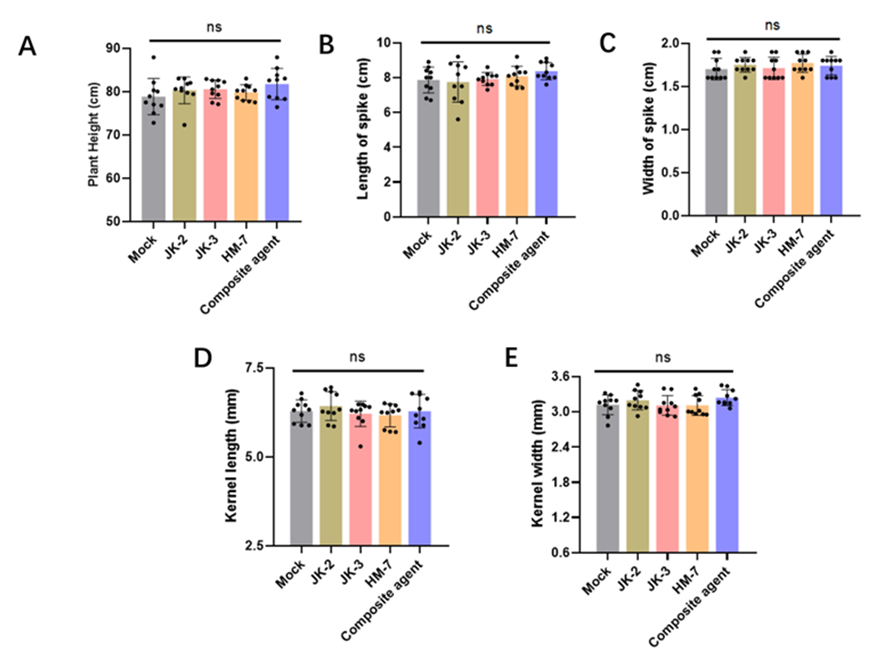
This study investigates the effects of microbial agents on the improvement of saline-alkali soil and the growth-promoting effects on wheat seedlings. Pot experiments were conducted with five treatments: a blank control, JK-2, JK-3, HM-7, and a composite microbial agent. The nitrogen, phosphorus, potassium content, and pH value of the soil before and after treatment were measured. Wheat indicators such as plant height, maximum leaf length, fresh weight, and dry weight were compared and analyzed. Additionally, a field experiment was conducted. The results showed significant changes in the nitrogen, phosphorus, and potassium contents, as well as a notable decrease in pH values after the application of microbial agents. The effect of increasing ammonium nitrogen content was ranked as composite agent > JK-2 > blank control > JK-3 > HM-7; the effect of increasing available phosphorus content was composite agent > JK-3 > HM-7 > JK-2 > blank control; the effect of increasing available potassium content was JK-2 > HM-7 > composite agent > JK-3 > blank control; and the decrease in pH was composite agent > JK-2 > JK-3 > HM-7 > blank control. Among these, the composite microbial agent increased ammonium nitrogen, available potassium, and available phosphorus by 172.23%, 90.42%, and 192.38%, respectively, compared to the blank group, and reduced the pH by 0.35, showing a good improvement effect on saline-alkali soil. The application of single microbial agents did not show significant growth-promoting effects on wheat seedlings, while the composite microbial agent showed significant differences. Wheat plant height, maximum leaf length, fresh weight, and dry weight increased by 22.02%, 18.97%, 33.7%, and 34.7%, respectively, compared to the blank control. Moreover, the field experiment demonstrated that the composite microbial agent significantly increased wheat yield. The composite microbial agent promoted the release and transformation of soil nutrients through its unique biological activity, thereby improving soil fertility. Additionally, its role in reducing soil pH helps improve the soil environment of saline-alkali land, creating more favorable conditions for plant growth, and shows a clear growth-promoting effect on wheat, providing data support for its application in saline-alkali soil improvement.