
Structural Modal Analysis and Supervised Machine Learning for Components of Kaplan Turbine’s Blade Adjusting Mechanism
##plugins.themes.bootstrap3.article.sidebar##
##plugins.themes.bootstrap3.article.main##
Abstract
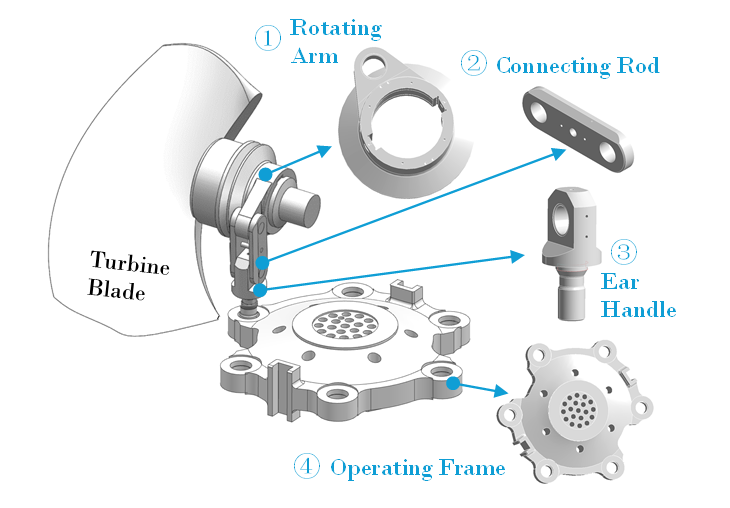
This study presents a comprehensive investigation into the dynamic behavior and resonance risks of the blade adjusting mechanism in Kaplan turbines, integrating structural modal analysis with supervised machine learning for predictive modeling. The research focuses on the four critical components of the mechanism—Operating Frame, Ear Handle, Connecting Rod, and Rotating Arm—due to their indispensable role in operational performance and documented failure cases. Finite element models were developed for each component, incorporating precise material properties and boundary conditions to perform a detailed structural modal analysis that extracted the first 20 natural frequencies and mode shapes. The results revealed distinct vibrational characteristics for each component and identified significant resonance risks across three key operational frequency bands: the runner rotational frequency (16.667 Hz), the blade passing frequency (100-300 Hz), and the guide vane interaction frequency (2000 Hz). Specifically, the first-order mode of the Connecting Rod was critically close to the rotational frequency, while high-order modes of the Rotating Arm and Ear Handle showed dangerous proximity to the 2000 Hz excitation. Beyond the modal analysis, this study pioneered the application of a Random Forest regression algorithm to predict modal frequencies based on mode order. The machine learning model demonstrated vastly superior performance compared to traditional Linear Regression, with significantly lower error metrics (RMSE, MAE) and higher accuracy (R²), effectively capturing complex non-linear relationships and component coupling effects revealed by statistical and correlation analysis. This hybrid methodology not only provides a profound understanding of the dynamic behavior and potential failure mechanisms in Kaplan turbine adjustment systems but also establishes a robust, data-driven framework for high-accuracy predictive modeling, paving the way for intelligent condition monitoring and predictive maintenance strategies in hydropower machinery.