
Bridging the Gap: An Analysis of Key Factors Driving Industry-Education Integration in Application-Oriented Undergraduate Institutions
##plugins.themes.bootstrap3.article.sidebar##
##plugins.themes.bootstrap3.article.main##
Abstract
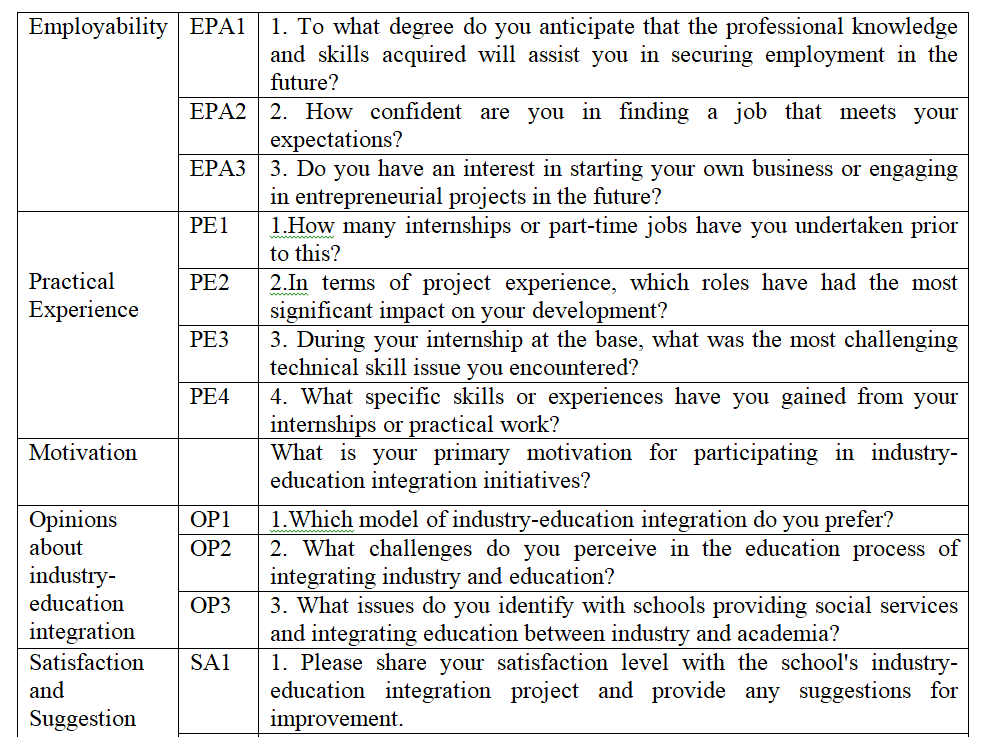
Industry-education integration (IEI) has emerged as a crucial strategy in China's higher education reform, particularly within application-oriented undergraduate institutions. Using Guangzhou as a case study, this research employed a mixed-methods approach, including questionnaires from 712 students and interviews with 10 teachers and corporate mentors, to examine multi-dimensional factors affecting IEI such as professional competence, employability, practical skills, motivation, participation modes, school satisfaction, and self-efficacy. Key findings include: (1) Professional competence and employability mutually reinforce each other, significantly enhancing student self-efficacy and challenging traditional linear views that treat self-efficacy primarily as a precursor to employment. (2) While students generally appreciate IEI initiatives, they highlight crucial shortcomings including a mismatch between educational content and industry requirements, limited variety in IEI models, and insufficient enterprise participation. These insights underscore policy implementation gaps and the need for increased incentives for enterprise involvement.