
Epigenetic Remodeling in the Tumor Microenvironment: A Novel Prognostic Signature for Glioblastoma Immunotherapy and Immune Evasion
##plugins.themes.bootstrap3.article.sidebar##
##plugins.themes.bootstrap3.article.main##
Abstract
Background: Glioblastoma multiforme (GBM) is the most aggressive primary brain tumor, characterized by high heterogeneity and poor prognosis. Despite advances in understanding its genetic and epigenetic alterations, prognostic models based on epigenetic modifications remain underexplored. This study aimed to develop a robust prognostic signature for GBM by integrating multi-omics data to unravel the molecular mechanisms underlying tumor progression and therapeutic resistance.
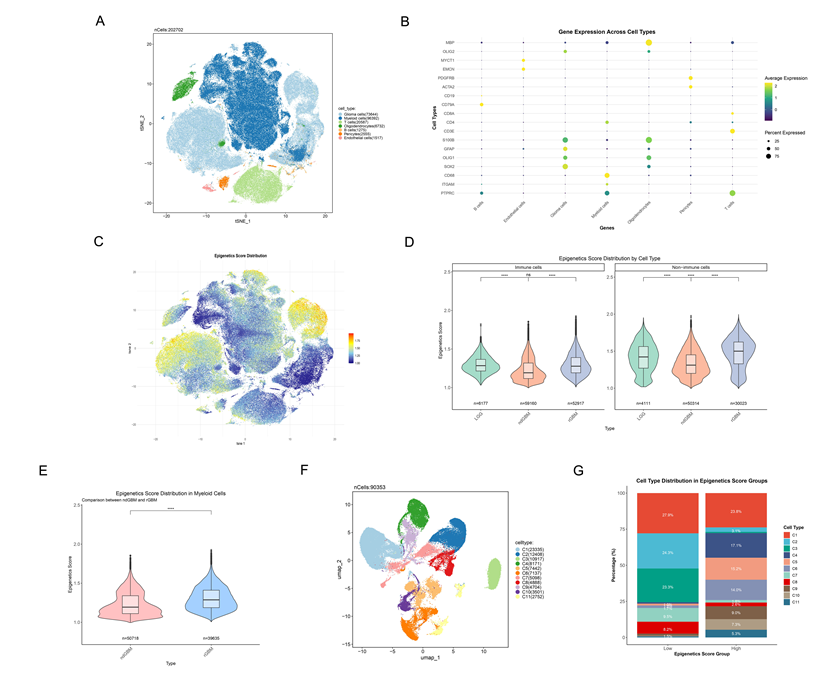
Methods: We analyzed single-cell transcriptome data (GSE182109) from 44 glioma samples, identifying seven distinct cell populations and quantifying epigenetic scores via ssGSEA based on 801 epigenetics-related genes from the EpiFactors database. Weighted gene co-expression network analysis (WGCNA) was performed on TCGA-GBM data to identify epigenetic modification-related genes. A Random Survival Forest (RSF) model was developed and validated using TCGA (n=153) and two CGGA cohorts (n=693 and n=325). Functional enrichment, pathway analysis, and tumor microenvironment characterization were conducted using GSEA, IOBR, and CIBERSORTx. Drug sensitivity analysis was performed, and pan-cancer validation was conducted across 29 TCGA cancer types.
Results: Single-cell analysis revealed elevated epigenetic scores in recurrent GBM (rGBM) compared to newly diagnosed GBM (ndGBM), particularly in myeloid cells (P<0.05). WGCNA identified 533 epigenetic modification-related genes, and the RSF model demonstrated superior prognostic performance with C-indices of 0.918 (TCGA), 0.605 (CGGA693), and 0.652 (CGGA325). High-risk patients showed enrichment in KRAS signaling (HR=2.31) and reactive oxygen species pathways (HR=1.89). Tumor microenvironment analysis revealed higher T-cell infiltration (P<0.001) and tumor neo-antigen burden (P=0.00497) in low-risk groups. Drug sensitivity analysis identified differential responses to temozolomide (P=0.0365) and paclitaxel (P=0.0262) between risk groups. Pan-cancer validation showed prognostic significance in Kidney Renal Clear Cell Carcinoma (HR>1, P<0.001).
Conclusion: This study developed a novel epigenetic signature that can effectively stratifies GBM patients into distinct prognostic groups, providing insights into tumor progression and treatment response. Further validation studies are needed to translate these findings into clinical practice.