
Predictive Value of the Novel Biomarker OS9 in Early-onset and Late-onset Fetal Growth Restriction
##plugins.themes.bootstrap3.article.sidebar##
##plugins.themes.bootstrap3.article.main##
Abstract
Aim: To evaluate the potential predictive value of maternal serum OS9 for FGR and its subtypes.
Methods: In this prospective nested case-control study, OS9 levels were measured from recruitment to delivery in pregnant women undergoing Down syndrome screening. We analyzed the changes in OS9 levels across different gestational periods. The predictive performance of OS9 for FGR and its subtypes was evaluated using receiver operating characteristic (ROC) curves.
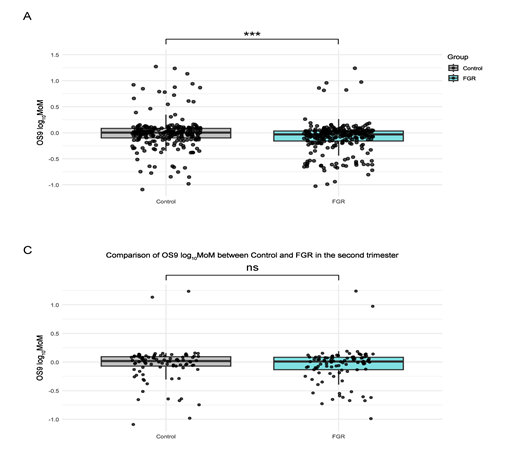
Results: In FGR pregnancies, OS9 levels showed a slight increase during early pregnancy but gradually decreased after 15 weeks with advancing gestational age. OS9 levels in the FGR group were significantly lower than those in the control group, particularly during the first and third trimesters. ROC curve analysis showed that OS9 alone had the highest AUC (0.815) for early-onset FGR in the third trimester, with a sensitivity reaching 0.923. Combining OS9 with maternal indicators markedly improved predictive performance. This was particularly evident in the third trimester, where the model incorporating all variables achieved an AUC of 0.869 for early-onset FGR, and the OS9-BMI or OS9-Age-BMI model achieved an AUC of 0.741 for late-onset FGR.
Conclusions: This study revealed the dynamic changes of OS9 levels. OS9 levels in the FGR group were significantly decreased in the first and third trimesters, suggesting that its potential as a novel biomarker for FGR prediction. ROC analysis demonstrated that OS9 alone had a certain predictive value for both early-onset and late-onset FGR, while its combination with maternal indicators significantly enhanced model performance, particularly in the third trimester.