
Research on the Intention of Grassroots Civil Servants for Human-AI Collaboration Based on the Integrative Framework for Collaborative Governance
##plugins.themes.bootstrap3.article.sidebar##
##plugins.themes.bootstrap3.article.main##
Abstract
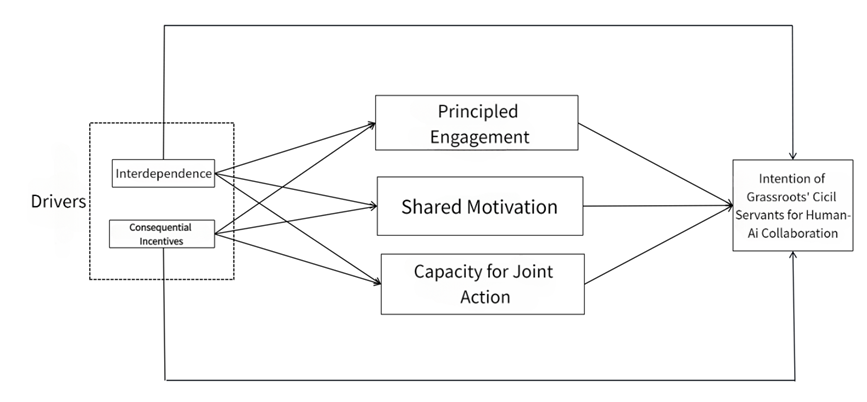
With the deep integration of artificial intelligence (AI) in grassroots governance, the collaboration between grassroots civil servants and intelligent systems has become a key issue in the construction of a digital government. Based on the Integrative Framework for Collaborative Governance, this paper constructs a comprehensive model that includes two types of drivers (interdependence, consequential incentives), three types of mediating variables (principled engagement, shared motivation, capacity for joint action), and collaboration intention, starting from the logic of "institutional environment—collaboration dynamics—collaboration intention." Empirical data from grassroots civil servants are used to test the model. The research results indicate: (1) Both interdependence and consequential incentives have a significant positive impact on the grassroots civil servants' intention to collaborate with AI; (2) Principled engagement, shared motivation, and capacity for joint action all play partial mediating roles between the two types of drivers and the collaboration intention. The study reveals the mechanisms behind the formation of grassroots civil servants' collaboration intention with AI. In the future, this collaboration can be promoted through institutionalized participation mechanisms and capacity co-construction.