
Design Development and Performance Verification of Passive Ventilation Device
##plugins.themes.bootstrap3.article.sidebar##
##plugins.themes.bootstrap3.article.main##
 https://orcid.org/0009-0007-2631-0305
Bei Hu
Haonan Chen
https://orcid.org/0009-0007-2631-0305
Bei Hu
Haonan Chen
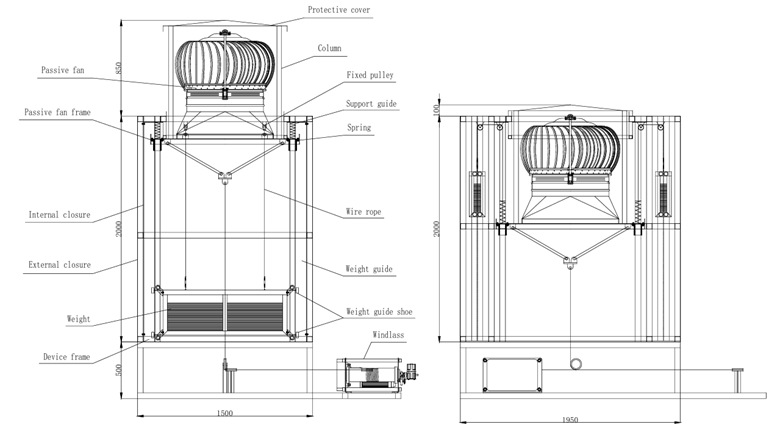
Abstract
To reduce reliance on safety-grade emergency AC power, the safety-grade ventilation system functions are implemented through passive technologies. For fuel buildings with relatively low sealing performance, a passive exhaust system for the fuel operation hall was designed. A set of emergency passive ventilation devices suitable for high spaces in nuclear power plants was developed. The experimental test, seismic analysis and wind load resistance analysis were carried out. The test results show that when the outdoor wind speed is 1 m/s, the ventilation volume of the passive ventilation device is 485 m3/h; when the indoor thermal pressure is 5 Pa, the ventilation volume is 3080 m3/h; when the indoor thermal pressure is 5 Pa and the outdoor wind speed is 1 m/s, the ventilation volume is 3130 m3/h. It can be seen that the ventilation volume increases slowly with the increase of outdoor wind pressure and significantly with the increase of indoor thermal pressure. The indoor thermal pressure plays a key role in the ventilation volume. After installing the purification device, the exhaust volume of the device decreased but still met the technical requirements and all the requirements of radiation protection in the nuclear safety guidelines. Through analysis and calculation, under eight typical equivalent seismic load combinations, the equivalent stress of the steel structure members, the surface stress of the wind turbine and the global deformation of the passive ventilation device are all within the limits, meeting the seismic functional requirements. Under the action of wind load, the mechanical indicators of the protective cover plate, the column and the wind turbine also meet the requirements of the specifications.