
Geometric Feature Extraction and Modeling of Chinese Calligraphy Strokes Based on Lie Group Transformations
##plugins.themes.bootstrap3.article.sidebar##
##plugins.themes.bootstrap3.article.main##
 https://orcid.org/0000-0002-5976-1782
Abstract
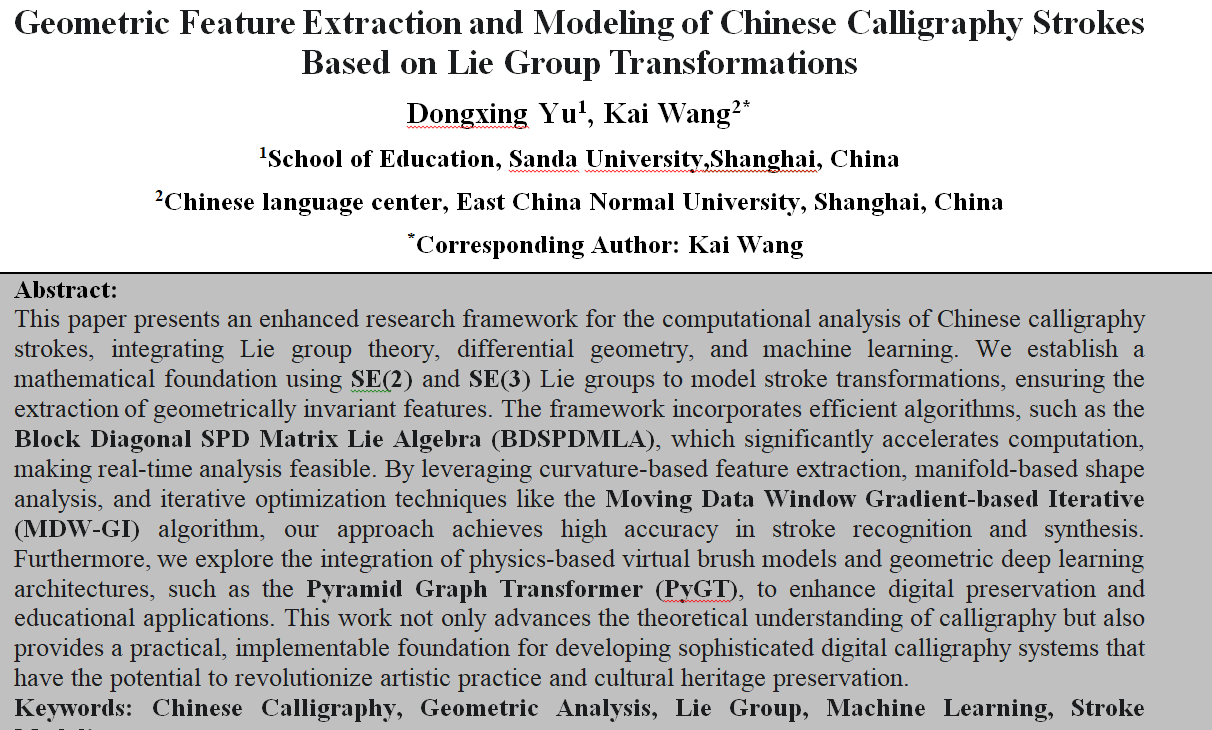
This paper presents an enhanced research framework for the computational analysis of Chinese calligraphy strokes, integrating Lie group theory, differential geometry, and machine learning. We establish a mathematical foundation using SE(2) and SE(3) Lie groups to model stroke transformations, ensuring the extraction of geometrically invariant features. The framework incorporates efficient algorithms, such as the Block Diagonal SPD Matrix Lie Algebra (BDSPDMLA), which significantly accelerates computation, making real-time analysis feasible. By leveraging curvature-based feature extraction, manifold-based shape analysis, and iterative optimization techniques like the Moving Data Window Gradient-based Iterative (MDW-GI) algorithm, our approach achieves high accuracy in stroke recognition and synthesis. Furthermore, we explore the integration of physics-based virtual brush models and geometric deep learning architectures, such as the Pyramid Graph Transformer (PyGT), to enhance digital preservation and educational applications. This work not only advances the theoretical understanding of calligraphy but also provides a practical, implementable foundation for developing sophisticated digital calligraphy systems that have the potential to revolutionize artistic practice and cultural heritage preservation.