
The Mediating Role of Sedentary Behavior between Social Support and Social Isolation: Ovarian Cancer in Elderly Women Cross-Sectional Study of Patients
##plugins.themes.bootstrap3.article.sidebar##
##plugins.themes.bootstrap3.article.main##
 https://orcid.org/0000-0002-9079-4945
Yi Chen
https://orcid.org/0009-0001-4518-7134
YuLin Zhou
https://orcid.org/0009-0006-9464-3104
https://orcid.org/0000-0002-9079-4945
Yi Chen
https://orcid.org/0009-0001-4518-7134
YuLin Zhou
https://orcid.org/0009-0006-9464-3104
Abstract
Background: Social isolation is a significant global public health issue for the elderly, posing severe challenges to social and public health, and significantly impacting the rehabilitation of elderly patients. While extensive research has been conducted on the epidemiology and influencing factors of social isolation, the potential mechanisms of social support and individual behavioral characteristics remain underexplored. Sedentary behavior and social support have been identified as key factors affecting social isolation; however, the relationship between sedentary behavior, social support, and social isolation remains unclear, particularly the mediating role of sedentary behavior, which has not been adequately studied in the context of elderly ovarian cancer patients in China.
Objective This cross-sectional study aims to investigate the current situation of social isolation and general influencing factors of elderly ovarian cancer patients. At the same time, it explores the relationship between sedentary behavior, social support and social isolation, and analyzes the mediating role of sedentary behavior in social support and social isolation.
Methods: A convenience sampling method was used to select elderly ovarian cancer patients treated and followed up at the First Affiliated Hospital of Zhejiang University School of Medicine, Zhejiang Province, China, from May 1, 2022, to December 31,2024. The study involved surveys using a general information questionnaire, the Lubben Social Network Scale-6, the Social Support Rating Scale, and the Chinese Adult Static Behavior Questionnaire.
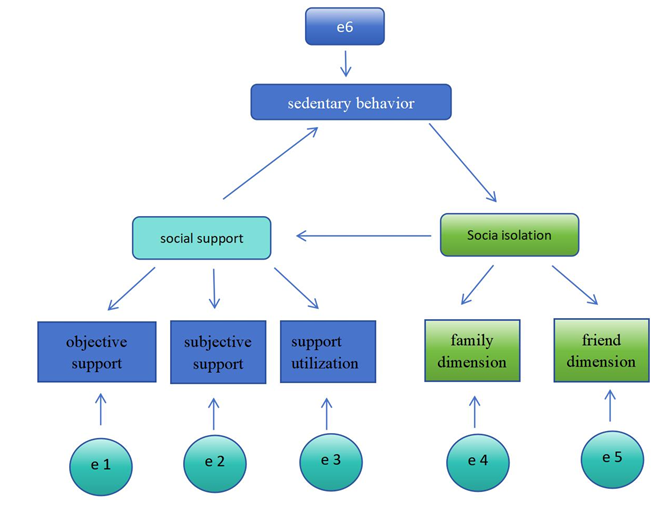
The average sedentary behavior duration for elderly ovarian cancer patients in our country is 6.96 (5, 10.29) hours per day, with a social support score of 31 (27,37) and a social isolation score of (9.13±0.87). The incidence of social isolation among elderly ovarian cancer patients is 80.4%, with 75.7% isolated by family and 89.7% by friends. In the general data, age, education level, place of residence, monthly income, disease duration, history of chronic diseases, and bone marrow suppression are the primary factors influencing social isolation in elderly ovarian cancer patients (P<0.05). Social support is negatively correlated with sedentary behavior time (r=-0.664, P<0.01) and positively correlated with social isolation scores (r=0.578, P<0.01). Sedentary behavior time is negatively correlated with social isolation (r=-0.291, P<0.01). Social support can directly influence social isolation or indirectly through sedentary behavior; sedentary behavior acts as a partial mediator between social support and social isolation in elderly ovarian cancer patients, with a mediation effect of-0.468, accounting for 45% of the total effect.
Conclusion: Elderly ovarian cancer patients in our country face a higher risk of social isolation. Particular attention should be given to those who are older, have lower education levels, live in urban areas, have lower monthly incomes, shorter disease durations, more than three comorbidities, and bone marrow suppression. These factors make elderly ovarian cancer patients more susceptible to social isolation, necessitating the development of personalized care interventions. Social support can directly or indirectly influence the level of social isolation among elderly ovarian cancer patients through sedentary behavior. Healthcare professionals should actively develop strategies to reduce sedentary behavior in elderly ovarian cancer patients, enhance social support, and prevent and delay the onset and progression of social isolation. This will promote the physical and mental health of elderly ovarian cancer patients and improve their quality of life.