
Research on Optimal Speed Prediction Technology for Submersible Permanent Magnet Synchronous Motor Direct Drive Cavity Pump System
##plugins.themes.bootstrap3.article.sidebar##
##plugins.themes.bootstrap3.article.main##
Abstract
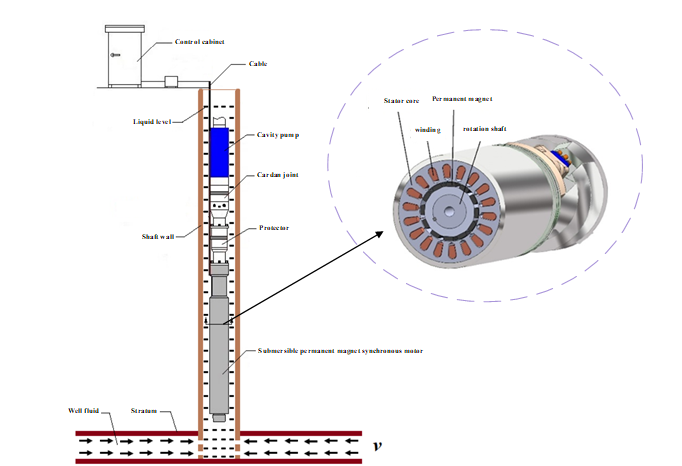
Optimizing the speed control of the submersible permanent magnet synchronous motor (SPMSM) in direct-drive cavity pump systems presents a significant challenge in the digital transformation of oilfield operations. A novel predictive model for determining the optimal pump speed is proposed, integrating an enhanced particle swarm optimization (PSO) algorithm with a neural network. The model zaccurately forecasts the optimal pump speed under diverse operational conditions, thereby improving both the performance and efficiency of the pumping system. Initially, key factors influencing the optimal rotational speed of the cavity pump were analyzed, including crude oil temperature, pressure differential, and volumetric efficiency. Two machine learning approaches—random forest model and the neural network model—were subsequently compared using experimental data to assess their predictive performance. An improved PSO algorithm was introduced, which combines dynamic inertia weight with the Cauchy mutation strategy to address these challenges. The dynamic inertia weight enhances the algorithm's global search capacity during the early stages of optimization, while the Cauchy mutation strategy improves local search efficiency and aids in avoiding local optima. Comparative analysis reveals that the proposed neural network model, integrated with the improved particle swarm optimization algorithm, significantly outperforms the random forest and unoptimized neural network models, demonstrating superior accuracy and stability and enabling more effective control of the SPMSM-driven pump system in oilfield operations.