
NIHSS: A Possible Predictor of Outcomes in Patients with Aneurysmal Subarachnoid Hemorrhage
##plugins.themes.bootstrap3.article.sidebar##
##plugins.themes.bootstrap3.article.main##
Abstract
Background: The National Institutes of Health Stroke Scale (NIHSS) is a powerful and commonly used tool for predicting the prognosis of patients with either ischemic stroke or intracerebral hemorrhage. In this study, we investigated whether a correlation exists between the NIHSS score and the prognosis in aSAH patients and examined the predictive ability.
方法: 本回顾性分析包括两组接受血管内弹簧圈栓塞治疗 aSAH 的患者。使用 Logistic 回归模型预测功能结果,在 3 个月时使用改良的 Rankin 量表 (mRS) 进行评估。采用决策曲线分析 (DCA) 和校准曲线来评估模型的预测准确性和可靠性。
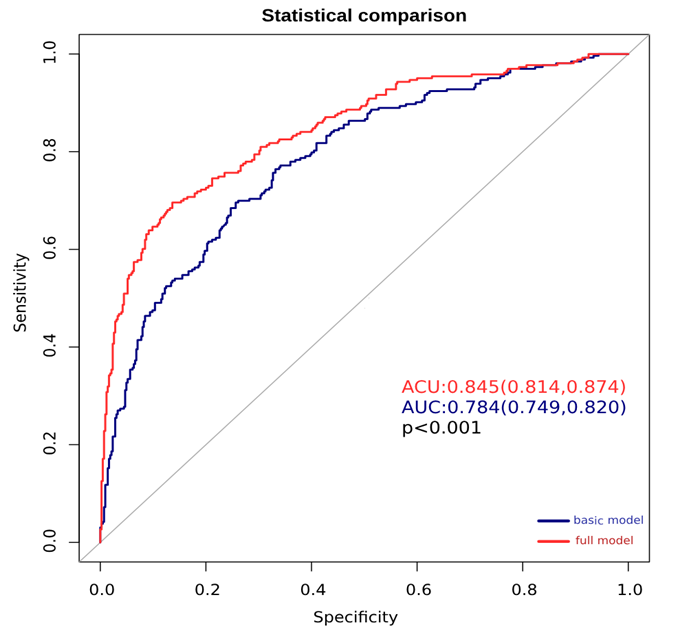
结果: 在推导队列中,入院时的 NIHSS (OR, 1.08;95% CI, 1.04–1.13, P < 0.001) 是 aSAH 患者 3 个月 mRS 的独立预测因子。NIHSS 的曲线下面积 (AUC) 为 0.806,CI为 95% (0.771, 0.841)。通过将 NIHSS 纳入基本模型,包括年龄、改良的 Fisher 量表评分和白细胞计数,观察到对不良结果的区分能力显着提高 (ACU 0.784 vs. 0.845)。在两个验证组中,将入院时的 NIHSS (OR, 1.08;95% CI, 1.04-1.11 和 OR, 1.2;95% CI, 1.04-1.38) 添加到基本模型中,导致整体性能的类似增加。
结论: 入院时 NIHSS 评分较高,显示接受血管内栓塞治疗 aSAH 的患者预后较差。