
Experimental Study on the Influence of Displacement Amplitude and Shear Rate on the Shear Characteristics of Pile-Soil Interface
##plugins.themes.bootstrap3.article.sidebar##
##plugins.themes.bootstrap3.article.main##
Abstract
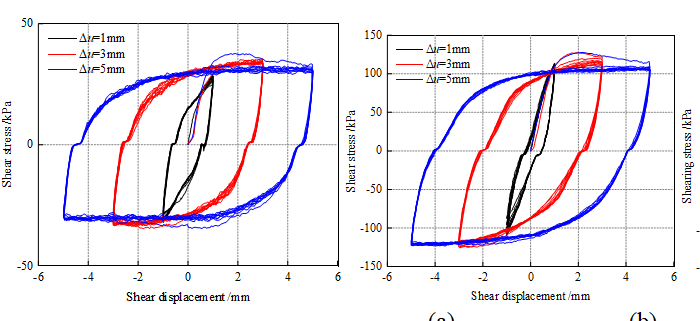
The mechanism of pile-soil interface interaction is an important research direction in geotechnical engineering. A large-scale, multifunctional soil-structure cyclic shear tester was utilized to systematically investigate the influence of shear rate and cyclic amplitude on the cyclic shear characteristics of the pile-soil interface. The variation laws of interface shear stress, bulk deformation characteristics, equivalent friction angle, and shear stiffness were analyzed. The experimental results indicate that the shape of the hysteresis curve transitions from a 'shuttle shape' to a 'parallelogram' with the displacement amplitude, and the peak shear stress at the interface exhibits a softening phenomenon. As the shear rate increases, the shear softening phenomenon diminishes. With increasing number of cycles, the peak interface shear stress exhibits a logarithmic decay. The primary characteristic of body deformation is shear shrinkage, which correlates positively with the shear displacement amplitude and negatively with the shear rate. The greater the normal stress, the more pronounced the cumulative vertical displacement becomes. The equivalent friction angle exhibits periodic fluctuations during the experimental process, with its amplitude increasing as the shear displacement amplitude increases. The interface friction angle under low normal stress conditions is larger than that under high normal stress conditions. The interface shear stiffness diminishes as the displacement amplitude increases, and the shear stiffness is lower under high normal stress conditions where the normal stress is greater. The amplitude of shear displacement significantly impacts the cyclic shear characteristics of the pile-soil interface, while the influence of the shear rate is relatively small.