
Triptolide Inhibits HIV Transcription Elongation through Ubiquitin-Dependent Proteasomal Degradation of Viral Tat Protein
##plugins.themes.bootstrap3.article.sidebar##
##plugins.themes.bootstrap3.article.main##
Abstract
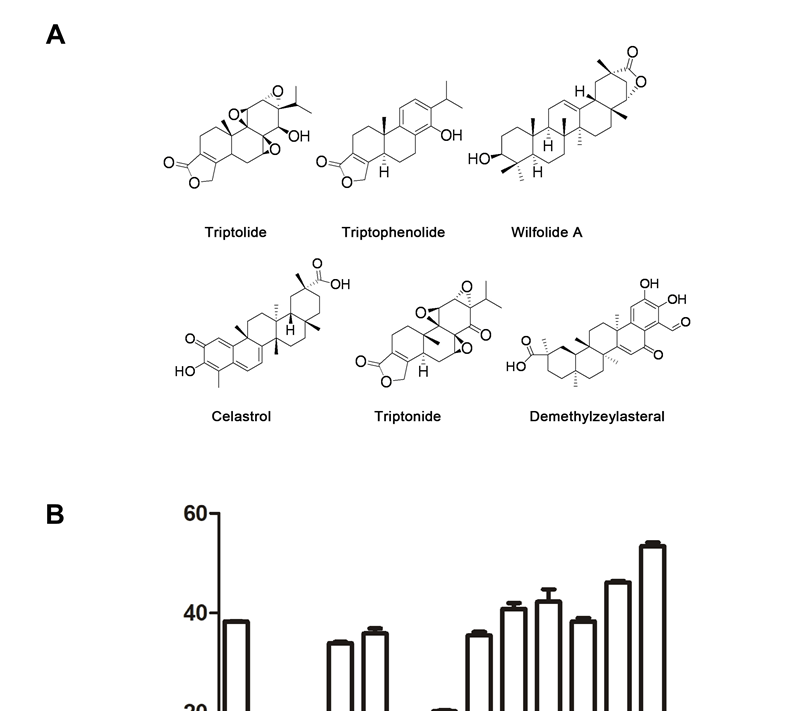
Tat protein, one of human immunodeficiency virus (HIV-1) specifically encoded gene products, plays a crucial role in HIV-1 transcription, which functions as “on and off” switch in HIV-1 latency and activation. Previous study has shown that triptolide (TPL) inhibits HIV-1 replication by promoting proteasomal degradation of Tat protein, but the mechanism of TPL-induced Tat degradation still remains elusive. Here, we compared with other active ingredients extracted from Tripterygium wilfordii, and found that TPL has a better effect on inhibition in HIV-1 transcription in a time and dose dependent manner. Our study indicates that TPL induced Tat degradation in an ubiquitin proteasome pathway, which is neither through blocking CycT1 protection for Tat, nor affecting transcription or translation of Tat. CUL4B is involved in Tat degradation under natural condition while not TPL treatment. Although mass spectrometry shows that TPL induces Tat K19 and K71 ubiquitination, single site mutation of either K19 or K71 as well as other lysine residues does not protect Tat from TPL, except that K41R shows partial resistance to TPL-induced Tat degradation. SILAC (stable isotopic labeling by amino acids in cell culture) analysis indicates that 17 E3 ubiquitin ligases maybe involved in TPL-induced Tat degradation. These findings provide novel insight to block HIV replication by promoting Tat degradation.