
Factors Associated with Conversion to General Anesthesia among Parturients Undergoing Cesarean Section with Neuraxial Anestheisa: A Case-Control Study
##plugins.themes.bootstrap3.article.sidebar##
##plugins.themes.bootstrap3.article.main##
Abstract
Objective
Pain during cesarean under neuraxial anesthesia is a concern for parturients. Some must convert to general anesthesia due to intense pain, increasing risks for the mother and neonate. The risk factors for this conversion are not well understood. We conducted a retrospective case-control study to identify potential independent factors.
Methods
We reviewed medical records to identify parturients who switched to general anesthesia during cesarean sections under initial neuraxial anesthesia and matched them 1:2 to the neuraxial anesthesia group. Univariate and multivariate binary logistic regression were used to analyze risk factors for conversion.
Result
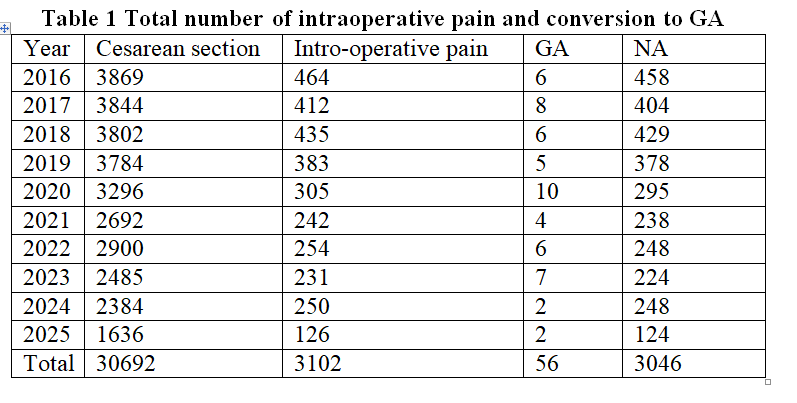
Between 2016 and 2025, 30,692 parturients at our hospital had cesarean sections with initial neuraxial anesthesia. Of these, 3102 experienced intraoperative pain, and 56 (1.8%) required conversion to general anesthesia due to severe discomfort. Univariate binary logistic regression identified risk factors including advanced age, BMI < 30, primigravidity, epidural anesthesia, repeat puncture, emergency surgery, and fatal weight. Multivariate regression showed advanced age, epidural anesthesia, repeat puncture, and emergency surgery as independent factors; fatal weight was marginally significant.
Conclusion
In conclusion, intraoperative pain is a common issue. The incidence of parturients converting from neuraxial to general anesthesia during cesarean delivery is low. Advanced age, multiple puncture attempts, initial epidural anesthesia, and emergency surgery are independent predictors of conversion to general anesthesia.
Keywords: Neuraxial anesthesia, General anesthesia, Cesarean section, Conversion