
Macroeconomic Costs and Benefits of Energy Storage Configuration in China: Evidence from a Storage-Augmented Multi-Regional CGE Framework
##plugins.themes.bootstrap3.article.sidebar##
##plugins.themes.bootstrap3.article.main##
Abstract
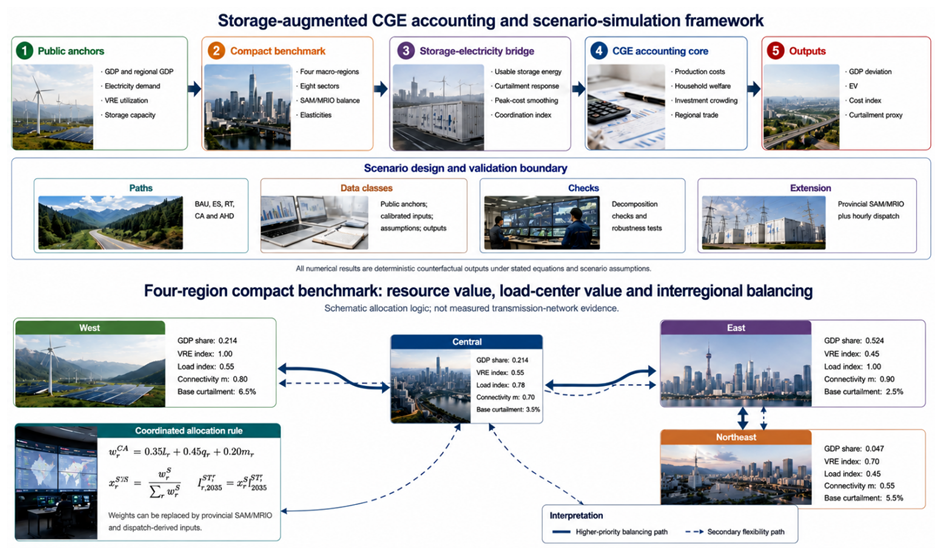
Energy storage is usually evaluated as a power-system flexibility technology, but its economy-wide value also depends on investment demand, electricity-cost pass-through, renewable curtailment, sectoral output and interregional trade. This paper develops a transparent storage-augmented multi-regional computable general equilibrium (CGE) framework for China and applies it to a counterfactual experiment for 2024-2035. The framework explicitly separates public 2024 data anchors, calibrated regional-sectoral inputs, exogenous scenario assumptions and deterministic model outputs. The benchmark uses official GDP, macro-regional GDP, electricity consumption, renewable generation, renewable utilization and new-type energy-storage statistics. The 2035 values are not observed data or point forecasts; they are model-generated counterfactual outcomes under stated allocation rules, battery-cost assumptions and storage-coordination parameters. The model links a compact four-region, eight-sector SAM/MRIO benchmark with a storage-augmented electricity module in which storage affects effective variable renewable electricity through curtailment reduction, peak-cost smoothing and interregional balancing. Five scenarios are evaluated: business-as-usual growth, economically sized storage, resource-targeted storage, coordinated allocation and accelerated high deployment. In the central experiment, coordinated allocation reaches 320 GW and 1280 GWh of new-type energy storage by 2035, lowers the electricity-cost index to 97.4 relative to BAU, reduces the wind-solar curtailment proxy to 4.6%, and raises equivalent variation by 0.47%. The accelerated high-deployment scenario installs more capacity but produces a smaller welfare gain. Additional decomposition and robustness checks show that this ranking is driven by the interaction of allocation quality, coordination and investment crowding rather than by an assumed capacity target alone. The paper contributes a reproducible data pipeline, an explicit storage-CGE accounting structure and regional allocation rules that can be extended with a full provincial SAM and hourly dispatch module.