
Predicting Varicella in Xuzhou City Using Autoregressive Integrated Moving Average Model
##plugins.themes.bootstrap3.article.sidebar##
##plugins.themes.bootstrap3.article.main##
Abstract
Background: Varicella remains a public health concern in Xuzhou, China, with documented seasonal patterns and declining incidence from 2018–2023. Accurate forecasting is critical for resource allocation.
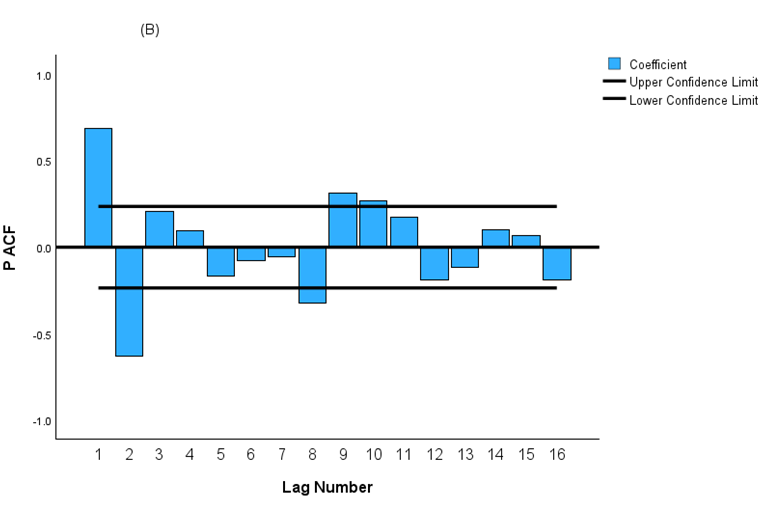
Methods: Monthly varicella cases (January 2018–December 2023) from China’s Disease Surveillance System were analyzed. A seasonal ARIMA model (ARIMA(p,d,q)(P,D,Q)₁₂) was developed using 2018–2023 data, with 2024 data for validation. Model selection criteria included Stationary R², Normalized BIC, and RMSE. Residual diagnostics involved Ljung-Box testing.
Results: Among 23,690 cases (2018–2023), incidence declined by 64.5% (peak: 5,718 cases in 2019; nadir: 2,027 cases in 2023), exhibiting bimodal seasonality (primary peak: October–January; secondary: May–August). ARIMA(2,0,0)(0,1,0)₁₂ demonstrated optimal fit (Stationary R²=0.813, Normalized BIC=9.693; all parameters p<0.001; residuals white noise, Ljung-Box p=0.210). Validation revealed systematic underprediction in spring (February–April: +81.97% to +79.03%) but alignment in May–December.
Conclusion: The ARIMA(2,0,0)(0,1,0)₁₂ model reliably forecasts varicella trends but underestimates spring incidence. Seasonal adjustments and real-time surveillance integration may enhance accuracy.