
A Multi-Scale Spatiotemporal Feature Self-Adaptive Fusion Model for Traffic Flow Prediction
##plugins.themes.bootstrap3.article.sidebar##
##plugins.themes.bootstrap3.article.main##
Abstract
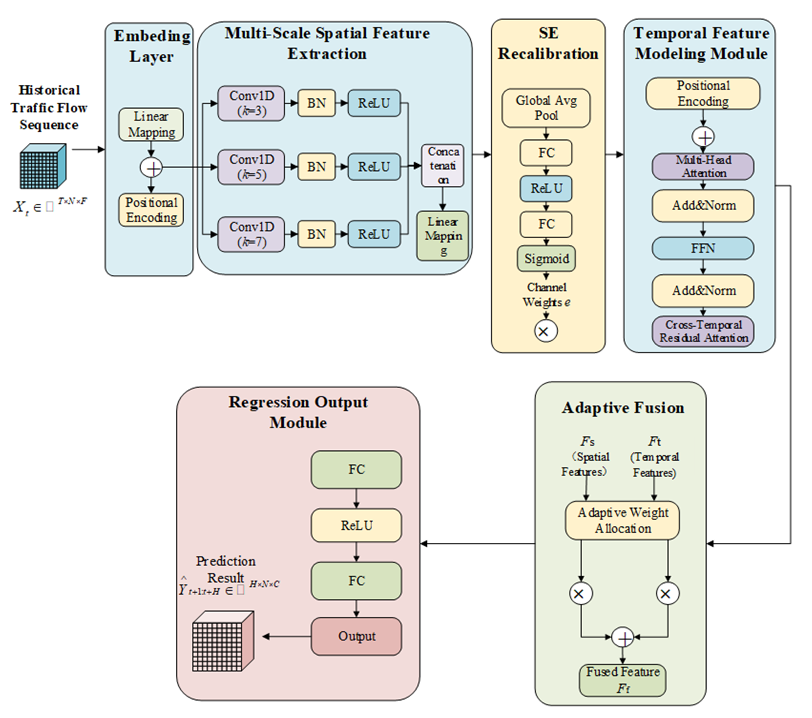
Accurate short-term traffic flow prediction remains challenging because of the nonlinear, multi-scale and spatiotemporally coupled nature of traffic data. To address these issues, this study proposes a multi-scale spatiotemporal feature adaptive fusion model, termed MSCA-Former. The model employs a multi-branch convolution structure to capture spatial features under different receptive fields, introduces an SE-based channel recalibration mechanism to enhance informative features adaptively, and incorporates a cross-time residual enhancement module to strengthen temporal dependency modelling. In addition, an adaptive feature fusion strategy is designed to improve the integration of spatial and temporal representations. Experiments on four public datasets, namely PEMS03, PEMS04, PEMS07 and PEMS08, show that the proposed model consistently outperforms seven representative baseline models. In particular, on the PEMS08 dataset, the proposed model reduces MAE, RMSE and MAPE by 7.5%, 12.0% and 8.6%, respectively, compared with the best baseline model. On the PEMS04 dataset, the corresponding reductions in MAE and MAPE are 7.6% and 4.1%, respectively. Ablation studies further confirm that the multi-branch convolution structure, channel recalibration mechanism and cross-time residual enhancement module all contribute positively to the overall model performance. These results indicate that MSCA-Former can effectively improve the representation and prediction of complex traffic flow patterns, providing an effective approach for short-term traffic flow forecasting in intelligent transportation systems.