
Nonlinear Association between Serum Folate and Zinc Concentrations in Children with Rickets: A Retrospective Cross-Sectional Study
##plugins.themes.bootstrap3.article.sidebar##
##plugins.themes.bootstrap3.article.main##
 https://orcid.org/0009-0008-8103-0354
Jiawei He
https://orcid.org/0009-0008-4595-2626
Baoxing Huang
Bingyan Chen
https://orcid.org/0009-0008-8103-0354
Jiawei He
https://orcid.org/0009-0008-4595-2626
Baoxing Huang
Bingyan Chen
Abstract
Abstract
Objective: Micronutrient interactions in disease states remain poorly understood. This study evaluated the association between serum folate (exposure) and zinc concentrations (outcome) in children with rickets.
Methods: This retrospective cross-sectional study enrolled 1,440 children with rickets from Shenzhen Children's Hospital (January 2022–December 2024). Serum folate (chemiluminescence immunoassay) and zinc (atomic absorption spectrophotometry) were measured. Covariates included sex and age. We employed multivariable linear regression with progressive covariate adjustment, generalized additive models for nonlinearity testing, and threshold effect analysis using two-piecewise linear regression.
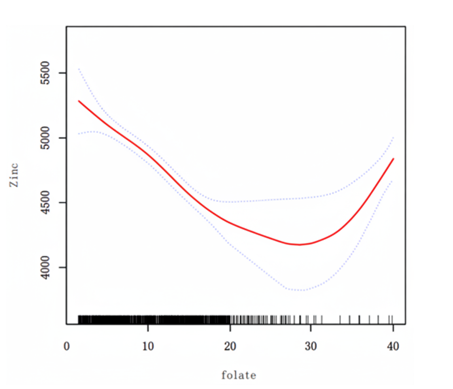
Results: Participants' mean age was distributed across tertiles, with 64.0% males. In adjusted models, each unit increase in folate was associated with a 12.5 nmol/L decrease in zinc (β=-12.5; 95% CI: -17.8 to -7.1; P<0.001). Threshold analysis identified a critical inflection point at folate 18.4 μmol/L. Below this threshold, each unit increase in folate corresponded to a 56.4 nmol/L decrease in zinc (β=-56.4; 95% CI: -67.9 to -44.9; P<0.001); above the threshold, the relationship reversed, with each unit increase in folate associated with an 18.7 nmol/L increase in zinc (β=18.7; 95% CI: 9.8 to 27.7; P<0.001). The two-piecewise model significantly outperformed the linear model (LRT P<0.001). The association was more pronounced in females (β=-19.9 vs. -9.5 in males; interaction P<0.05).
Conclusion: A nonlinear, biphasic relationship exists between folate and zinc in children with rickets, with a threshold at 18.4 μmol/L. These findings suggest precision nutrition strategies should consider baseline folate status when managing zinc homeostasis in rickets.