
Research on Short-Term Photovoltaic Power Generation Forecasting Based on GA-BiLSTM-Attention
##plugins.themes.bootstrap3.article.sidebar##
##plugins.themes.bootstrap3.article.main##
 https://orcid.org/0009-0001-9814-5237
Kai Xiao
Xue Liu
Cheng Dai
Zhijiang Wen
https://orcid.org/0009-0001-9814-5237
Kai Xiao
Xue Liu
Cheng Dai
Zhijiang Wen
Abstract
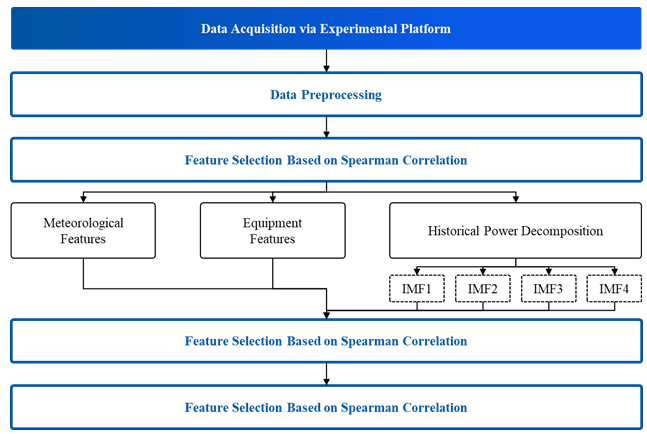
Photovoltaic (PV) power generation exhibits randomness and volatility, making high-accuracy day-ahead forecasting crucial for grid stability. This paper proposes a hybrid model, GA-BiLSTM-Attention, combining multi-scale Gaussian filtering decomposition with genetic algorithm optimisation to address issues such as prediction delay and model generalisation. Core features, irradiance and backplate temperature, are selected based on the Spearman correlation coefficient. Multi-scale Gaussian filtering decomposes historical power data into four intrinsic mode functions (IMFs), with delay decomposition to prevent data leakage. A BiLSTM-Attention architecture captures both forward and backward temporal dependencies, while attention focuses on key features. The genetic algorithm optimises hyperparameters like hidden layer dimensions, learning rate, and dropout rate. Validation using data from a 9.2 kWp PV platform in Xichang City shows that the proposed model achieves RMSE, MAE, and MAPE of 0.287 kW, 0.217 kW, and 13.81%, respectively, outperforming baseline LSTM and other comparative models. This model provides a high-accuracy, low-complexity solution for day-ahead PV power forecasting.