
Limb Fatness Increases the Risk of Heart Failure: A Mendelian Randomization Study
##plugins.themes.bootstrap3.article.sidebar##
##plugins.themes.bootstrap3.article.main##
Abstract
Background. Numerous observational studies have indicated an association between obesity and heart failure (HF) risk. However, no consistent conclusions have been reached regarding the relationship between regional body fat and HF, and the causal relationship remains unclear. Our study aimed to evaluate the relationship between regional body fat and HF.
Methods. We conducted a two-sample Mendelian randomization (MR) to ascertain the causal association between regional body fat and HF. Single-nucleotide polymorphisms (SNPs) correlated with regional body fat were extracted from several genome-wide association studies (GWAS) with more than 400,000 individuals. Summary statistics for HF were obtained from the FinnGen consortium, which comprised 3,903 cases and 114,735 controls. The analysis utilized the inverse variance-weighted (IVW), MR-Egger, and weighted median (WME) methods. Sensitivity tests were also performed, including the MR-Pleiotropy Residual Sum and Outlier (MR-PRESSO), MR-Egger intercept tests, and leave-one-out analysis.
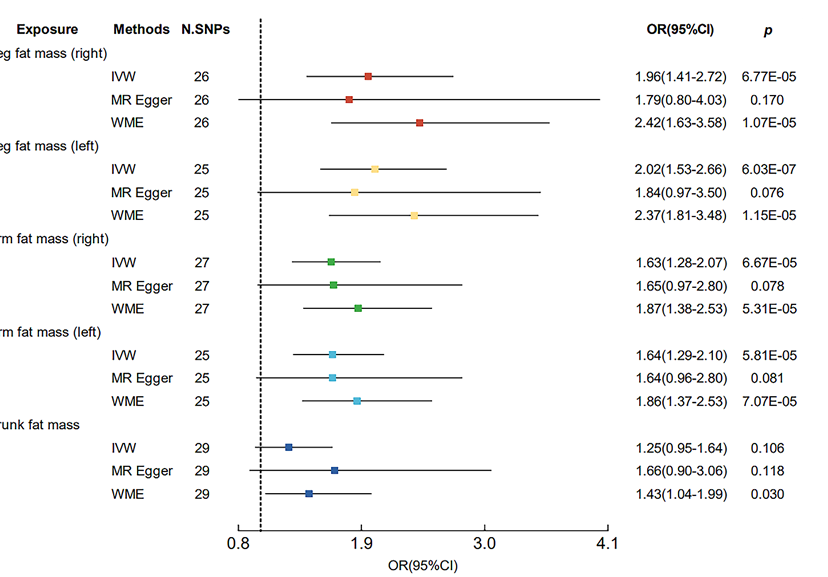
Result. Genetically predicted per one standard deviation (SD) increased regional body fat, including the left leg, right leg, left arm, and right arm fat mass, increased the HF risk with ORs of 1.96, 2.02, 1.63, and 1.64, respectively. The sensitivity assessments confirmed that our results were reliable and stable.
Conclusions. Our study demonstrated a causal association between regional body fat and an increased risk of HF. These findings may contribute to the development of HF prevention strategies.