
A Novel Method for Predicting the Fall Ratio of Kill Fluids Based on the XGBoost Model
##plugins.themes.bootstrap3.article.sidebar##
##plugins.themes.bootstrap3.article.main##
Abstract
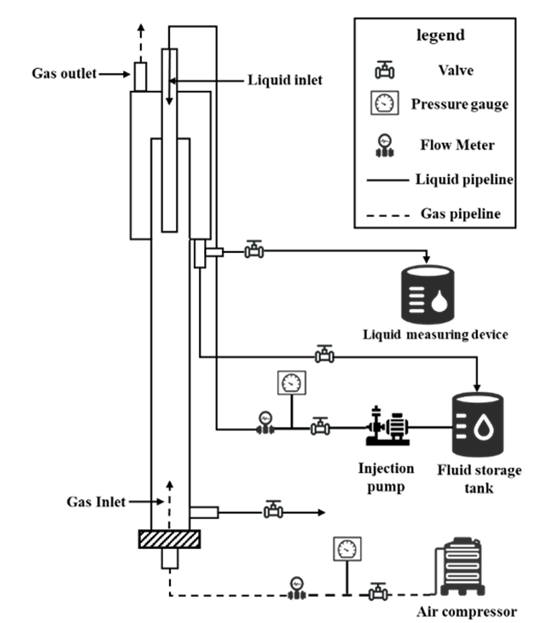
With the advancement of oil and gas exploration into deep and ultra-deep formations, drilling operations face increasingly complex geological conditions, resulting in a higher risk of well blowouts. During a blowout, drilling fluid is rapidly expelled from the wellbore, making conventional well-killing methods ineffective. In such cases, the ability of the kill fluid to descend to the bottom of the well is critical for blowout control and operational safety.To accurately predict the fall ratio of kill fluid, this study proposes an intelligent prediction method based on the XGBoost model. A wellbore kill-fluid descent experimental system was constructed, and experiments were conducted under various gas–liquid velocity conditions. A dataset incorporating gas–liquid velocities, fluid physical properties, and rheological parameters was established and normalized for model training. Key hyperparameters of the XGBoost model were optimized to improve predictive performance.The results show that the proposed model achieves an MSE of 0.004, an RMSE of 0.066, and an MAE of 0.046, with both R² and EVS reaching 0.962. Compared with Random Forest, Gradient Boosted Decision Tree, Linear Regression, and Multi-Layer Perceptron models, the proposed method demonstrates superior accuracy and robustness. Prediction errors remain within 10% of experimental measurements, confirming the reliability of the model.Overall, this study provides an efficient and accurate approach for predicting the kill-fluid fall ratio, offering valuable support for well-killing operations.