
Resolving the Intention–Behavior Gap in Smes’ AI Adoption: Evidence from a Cognitive–Affective Dual-Path Model in Western China
##plugins.themes.bootstrap3.article.sidebar##
##plugins.themes.bootstrap3.article.main##
Abstract
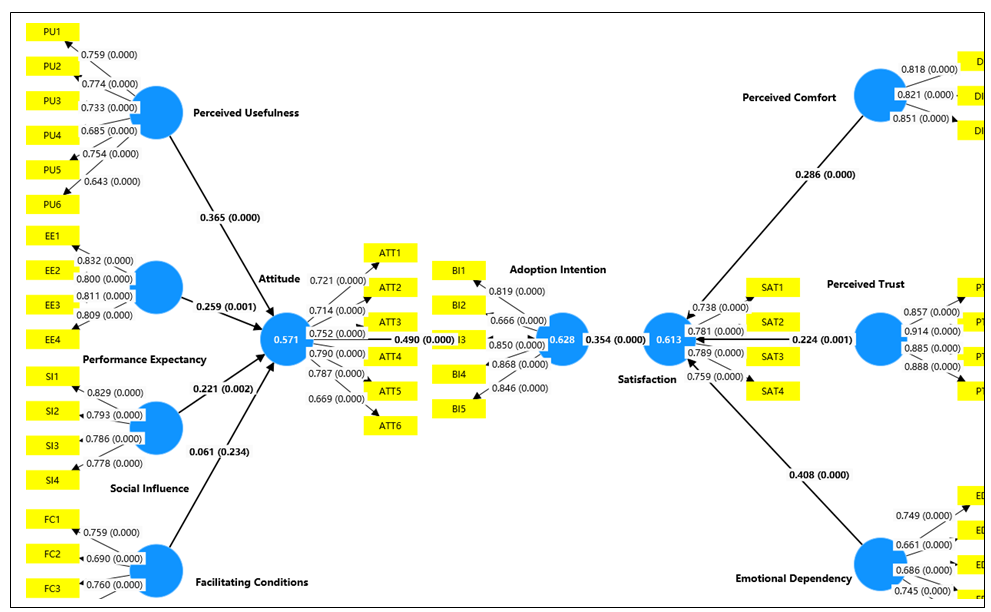
Abstract: To address the “intention-behavior gap” in small and medium-sized enterprises (SMEs)’ adoption of artificial intelligence (AI) technology, this study constructs a cognitive-affective dual-path integrated model based on the TAM-UTAUT framework and affect-cognition interaction theory. Using PLS-SEM, we analyze survey data from 198 business owners in Southwest and Northwest China to systematically reveal the technological decision-making mechanism. The results show that in the cognitive path, perceived usefulness, performance expectancy, and social influence significantly drive adoption intention through attitude as a mediator, while facilitating conditions have no significant effect. In the affective path, perceived comfort, perceived trust, and emotional dependence form parallel driving forces via satisfaction. A comparison of the dual paths indicates that cognitive evaluation is slightly stronger than the affective mechanism, and their dynamic coupling determines the efficiency of converting adoption intention into actual behavior. Moderation analysis reveals that at the individual trait level, educational background weakens the role of facilitating conditions, and work experience reduces the marginal benefit of perceived comfort. At the contextual level, the effect of performance expectancy in manufacturing is 2.3 times that in the service industry. This study transcends the single rational decision-making paradigm, confirms the critical role of emotional dependence, and expands the contextual boundary of TAM- UTAUT theory to SMEs. Practically, it proposes a “context-adaptive” strategy: strengthening the dissemination of industry benchmarks for low-education groups, designing quantitative performance schemes focused on manufacturing, and reducing senior owners' technological alienation through emotional design, thereby providing a new path to resolve the “intention-behavior gap”.