
Construct and Verify a Prediction Model for the Risk of Stroke in Community Patients with Chronic Obstructive Pulmonary Disease Based on Machine Learning Methods
##plugins.themes.bootstrap3.article.sidebar##
##plugins.themes.bootstrap3.article.main##
Abstract
Abstract
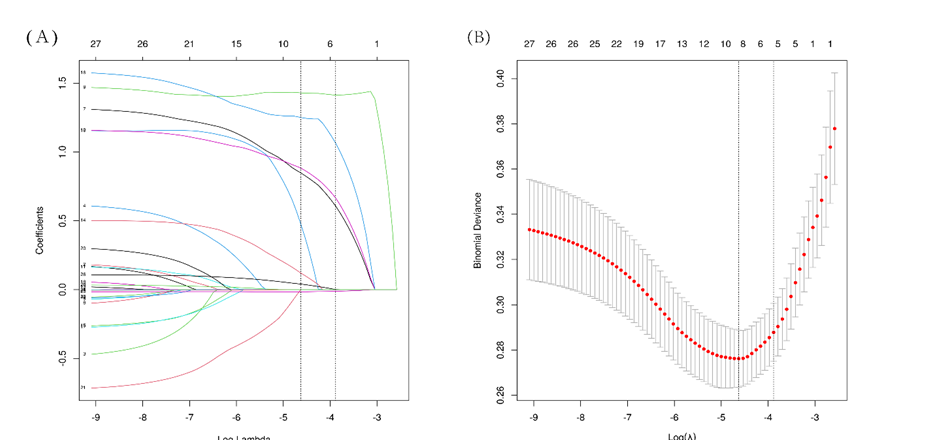
Background: The occurrence of stroke in patients with chronic obstructive pulmonary disease (COPD) may bring potential devastating consequences; however, there still lacks a predictive model that can accurately predict the risk of stroke in community COPD patients. The purpose of this study is to construct a new predictive model through machine learning methods, which can accurately predict the risk of stroke in community COPD patients. Methods: The clinical data of 809 community COPD patients were analyzed using the 2020 China Health and Retirement Longitudinal Study (CHARLS) database. The least absolute shrinkage and selection operator (LASSO) and multiple logistic regression were used to analyze the predictors.Multiple machine learning (ML) classification models were integrated for analyzing and identifying the best model. And Shapley additive explanations (SHAP) were developed for personalized risk assessment. Results: The following six variables: Heart_disease, hyperlipidemia, hypertension, ADL_score, Cesd_score and Parkinson,disease are predictors of stroke in community-based COPD patients.The logistic classification model is the optimal model.The area under the curve (AUC) (95% confidence interval, CI) in the test set: 0.913 (0.835-0.992),accuracy:0.823, sensitivity: 0.818, and specificity: 0.823.
Conclusions: The model constructed in this study has relatively reliable predictive performance, which helps clinical doctors identify high-risk populations of community COPD patients prone to stroke at an early stage.