
Tool Wear Prediction Based on LSTM-MSCNN Fusion Model and Multi-source Time-frequency Characteristics
##plugins.themes.bootstrap3.article.sidebar##
##plugins.themes.bootstrap3.article.main##
Abstract
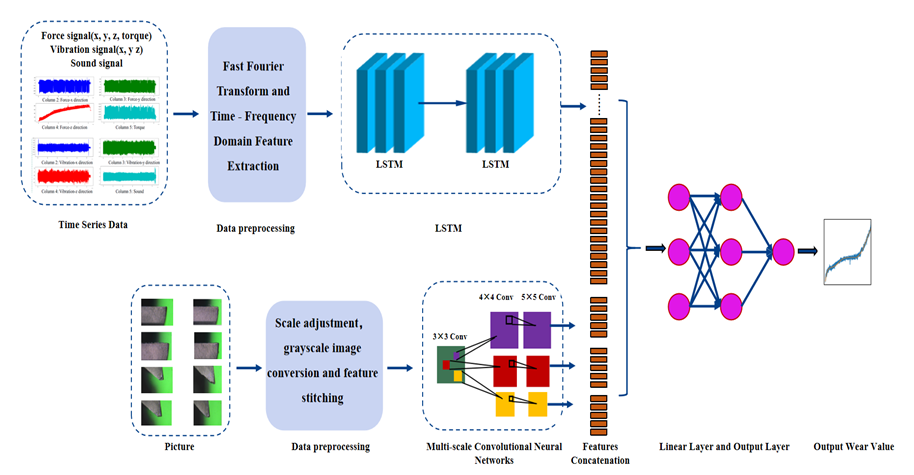
Accurate tool wear prediction is pivotal for ensuring machining quality, extending tool lifespan, and reducing operational and maintenance costs. However, modelling the complex spatio-temporal dependencies in multi-source heterogeneous sensor data remains a major challenge. This study proposes LSTM-MSCNN, a hybrid deep learning framework that synergistically combines Long Short-Term Memory (LSTM) networks for modelling long-range temporal dependencies with Multi-Scale Convolutional Neural Networks (MSCNN) for extracting hierarchical spatial features across multiple receptive fields. The model incorporates five heterogeneous sensor modalities--cutting force, torque, image, vibration, and acoustic emission--to build a unified time-frequency feature representation, consisting of 13 time-domain and 8 frequency-domain descriptors, enabling the joint exploitation of temporal dynamics and spatial correlations. The proposed architecture is validated on the Qilu Institute of Technology Coated End Milling Cutter (QIT-CEMC) dataset, obtained from real-world coated end milling operations under varying cutting parameters and material conditions. Comparative experiments against strong baselines, including standalone LSTM, ResNet, and MSCNN models, demonstrate that LSTM-MSCNN achieves superior predictive performance, with a mean squared error (MSE) of 0.406 and a mean absolute error (MAE) of 0.286. These results confirm the model’s high accuracy, enhanced generalization capability, and robustness in complex machining environments. The proposed method provides a practical and scalable solution for intelligent manufacturing systems, offering valuable guidance for predictive maintenance, process optimization, and decision-making in advanced machining applications.