
Social Isolation Status and Associated Factors in Elderly Patients with Ovarian Cancer: A Cross-Sectional Assessment
##plugins.themes.bootstrap3.article.sidebar##
##plugins.themes.bootstrap3.article.main##
 https://orcid.org/0009-0001-4518-7134
Jiaojiao Jin
https://orcid.org/0009-0001-4518-7134
Jiaojiao Jin
Abstract
Background: Social isolation is an increasingly serious public health problem affecting the elderly population. Although extensive researchs have been conducted on the current status and risk factors of the general elderly population, the social isolation status and related influencing factors of elderly patients with ovarian cancer, which are disease-specific, have not been sufficiently studied。
Objective: Assessing the status of social isolation and analyzing its influencing factors among elderly ovarian cancer patients.
Method:The study enrolled 229 elderly ovarian cancer patients who received treatment at a tertiary hospital in Hangzhou from May 1, 2022, to October 31, 2024, using convenience sampling. A cross-sectional survey was conducted utilizing the following instruments: a general information questionnaire, the Lubben Social Network Scale (LSNS-6), the Social Support Rating Scale (SSRS), the UCLA Loneliness Scale, and the Edmonton Symptom Assessment Scale (ESAS).
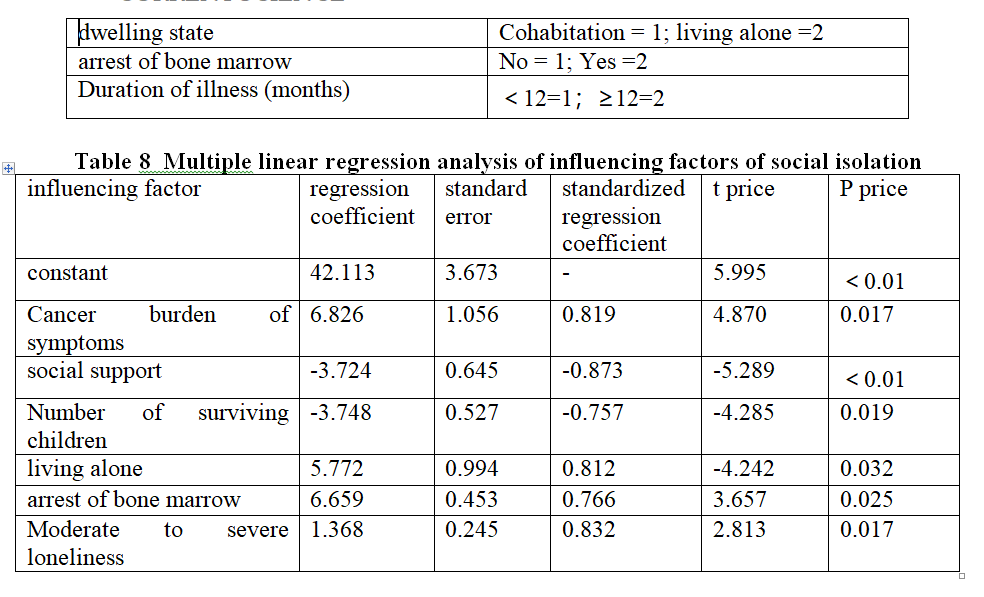
Results: Among 229 elderly ovarian cancer patients, the average scores for social isolation were (10.16±2.03), family isolation (6.25±1.14), and friend isolation (3.89±0.84). The incidence rates of social isolation, family isolation, and friend isolation were 67.25%,33.19%, and 72.93%, respectively. Multivariate linear regression analysis showed that the number of surviving children, bone marrow suppression, living alone, moderate to severe loneliness, social support, and cancer symptom burden were the main factors influencing social isolation in elderly ovarian cancer patients ( P<0.05).
Conclusion: Elderly ovarian cancer patients exhibit significantly higher levels of social isolation, particularly manifesting more pronounced friend isolation than family isolation. Clinical practitioners should prioritize screening for social isolation in this population, with special attention to those demonstrating the following risk factors: limited surviving offspring, solitary living arrangements, chemotherapy-induced bone marrow suppression, inadequate social support networks, moderate-to-severe loneliness, and high symptom burden. Implementing targeted psychosocial interventions is crucial to mitigate the onset and progression of social isolation, thereby enhancing both psychological well-being and quality of life in this vulnerable patient group.