
English English
##plugins.themes.bootstrap3.article.sidebar##
##plugins.themes.bootstrap3.article.main##
Abstract
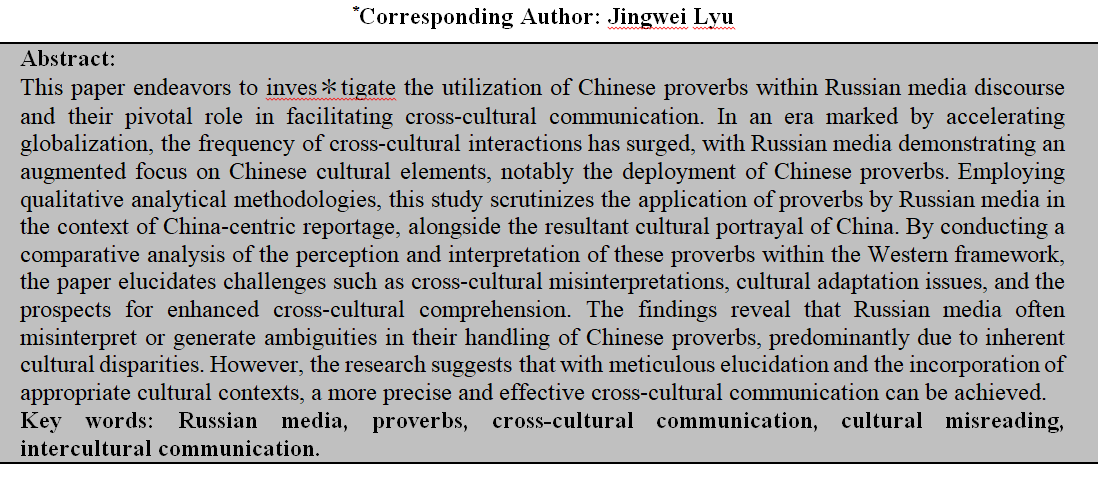
This paper endeavors to investigate the utilization of Chinese proverbs within Russian media discourse and their pivotal role in facilitating cross-cultural communication. In an era marked by accelerating globalization, the frequency of cross-cultural interactions has surged, with Russian media demonstrating an augmented focus on Chinese cultural elements, notably the deployment of Chinese proverbs. Employing qualitative analytical methodologies, this study scrutinizes the application of proverbs by Russian media in the context of China-centric reportage, alongside the resultant cultural portrayal of China. By conducting a comparative analysis of the perception and interpretation of these proverbs within the Western framework, the paper elucidates challenges such as cross-cultural misinterpretations, cultural adaptation issues, and the prospects for enhanced cross-cultural comprehension. The findings reveal that Russian media often misinterpret or generate ambiguities in their handling of Chinese proverbs, predominantly due to inherent cultural disparities. However, the research suggests that with meticulous elucidation and the incorporation of appropriate cultural contexts, a more precise and effective cross-cultural communication can be achieved