
Enhanced Tilapia Pathology Detection via Dense-Yolov11 with Attention Mechanisms
##plugins.themes.bootstrap3.article.sidebar##
##plugins.themes.bootstrap3.article.main##
Abstract
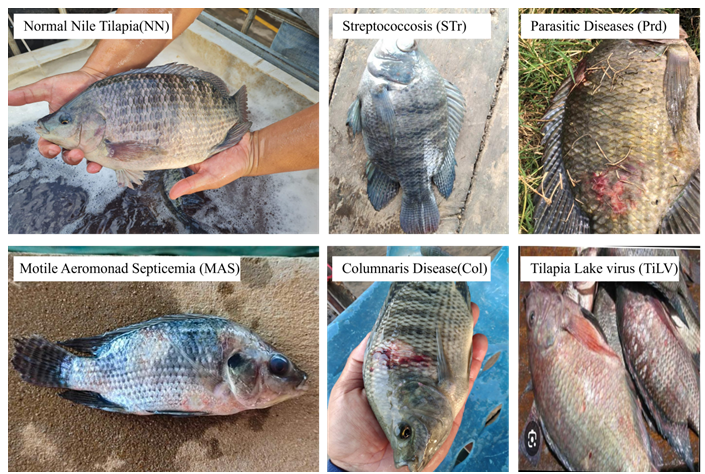
Aquaculture faces significant economic losses due to fish diseases, necessitating efficient and accurate early detection methods. This study develops an enhanced YOLOv11-based framework for tilapia disease detection using the Kaggle "Identifying Disease in Nile Tilapia" dataset. The baseline YOLOv11 model achieved P=92.7, mAP=85.2, R=90.3, and F1=88.8. We integrated DenseNet to improve feature reuse and compared CBAM with ECAAttention mechanisms. The optimized model demonstrates significant performance gains: mAP50 increased by 4.3% to 94.6%, with F1-score reaching 91.4%. Notably, it achieves 98.7% precision in eye abnormality detection (8% bounding box accuracy improvement) and 96.3% mAP50 for gill lesions. Detection accuracies for fin and body surface abnormalities improved by 10.6% and 8.7% respectively. The cross-layer feature fusion technique effectively addresses feature attenuation in traditional models when processing fine pathological features (eyes/gill filaments), demonstrating the robustness of dense connections in complex backgrounds. Final metrics show 93.9% accuracy (Box(P)) and 89.0% recall (R). This work advances aquaculture diagnostics through algorithmic innovation, shifting from passive treatment to active prevention via early pathological feature analysis. The proposed method provides a high-precision solution with substantial industrial application potential.