
Rock Mass Point Cloud Registration Based on Feature Extraction and Polyhedral Topology Mapping
##plugins.themes.bootstrap3.article.sidebar##
##plugins.themes.bootstrap3.article.main##
Abstract
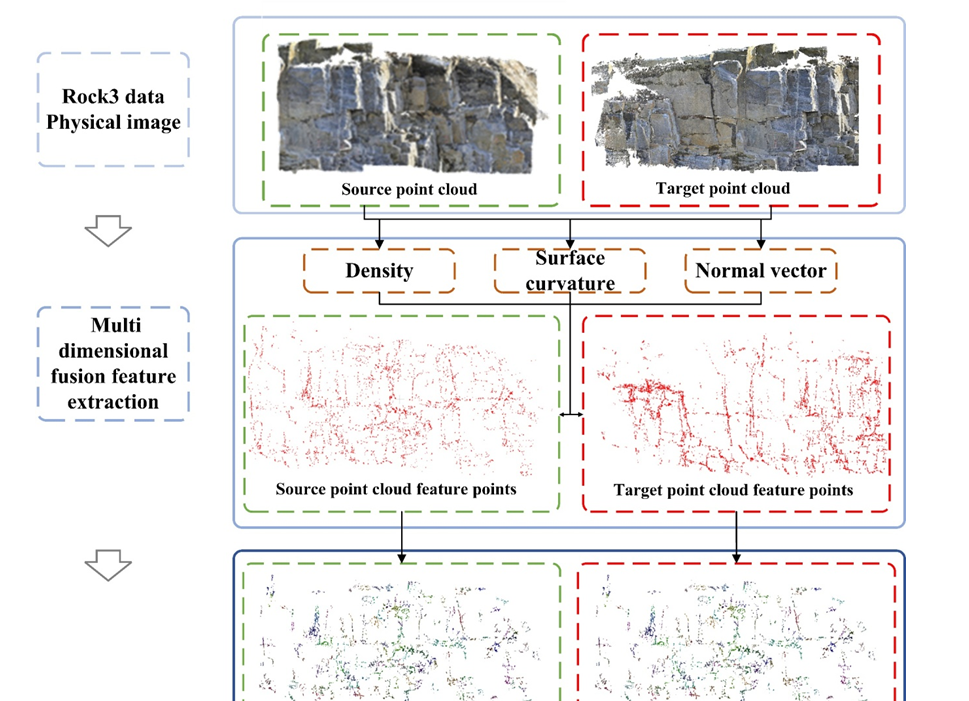
Rock mass point cloud registration is a fundamental step in studying the three-dimensional characteristics of rock masses. The complex geometry and uneven density distribution of rock surfaces often complicate feature extraction, affecting registration accuracy. Addressing these issues, we propose a novel registration algorithm that utilizes neighborhood multi-dimensional feature extraction and spatial tetrahedral descriptors. We integrate point cloud density, normal vectors, and surface curvature to extract clusters of feature points, and take the centroid of these clusters as the feature points of the rock mass. Then, we construct spatial tetrahedron descriptors for the feature points to identify corresponding points and calculate transformation matrices for coarse registration. Subsequently, the Iterative Closest Point (ICP) algorithm is applied for fine registration. The experiments conducted on the Rock bench dataset, WHU-TLS dataset, and real-world dataset show that the proposed method extracts more comprehensive and accurate feature points than curvature based feature algorithms, normal based feature extraction algorithms, Gaussian curvature algorithms, and SVF algorithms. Applying the feature points extracted by each method to the spatial tetrahedral descriptor proposed in this paper for coarse registration, and then using the ICP algorithm for fine registration, our accuracy improved by 96.06%, 94.3%, 65.6%, and 77.8% compared to other methods.
Finally, this article analyzed the overlap and initial position robustness of the registration method, and compared its accuracy with ICP, LM-ICP, and NDT methods, demonstrating the effectiveness of this method.