
Examining Resources and Capabilities for Corporate Sustainability: A Systematic Literature Review and Interviews with Practitioners
##plugins.themes.bootstrap3.article.sidebar##
##plugins.themes.bootstrap3.article.main##
Abstract
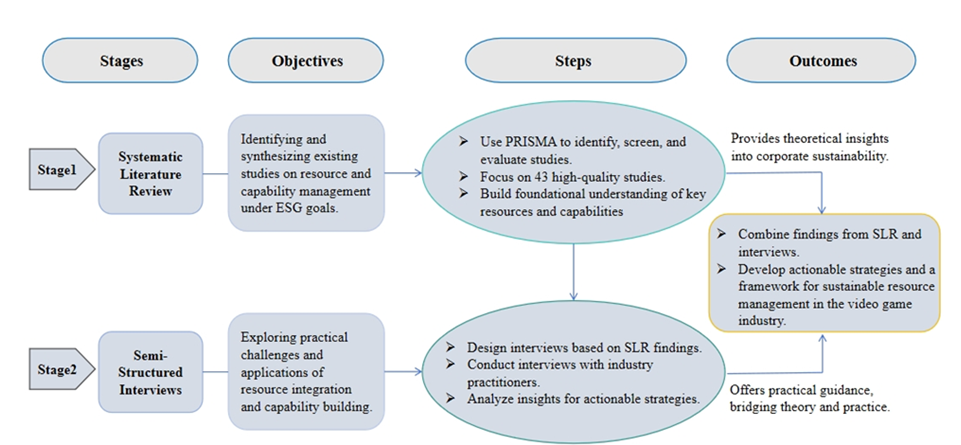
Effective resource and capability management is crucial for achieving Environmental, Social, and Governance (ESG) goals, particularly in industries facing rapid technological and regulatory changes. In China’s rapidly evolving video game industry—one of the largest and most innovative globally—challenges such as technological advancement, resource integration, and aligning innovation with ESG requirements remain underexplored, despite their critical importance for long-term sustainability. This study bridges this gap by combining a Systematic Literature Review (SLR) of 43 studies with semi-structured interviews of 10 industry leaders, offering a dual-method approach to analyze key resources and dynamic capabilities driving corporate sustainability. Grounded in an integrated framework of Resource-Based View (RBV), Dynamic Capabilities View (DCV), Resource Orchestration Theory (ROT), and Triple Bottom Line (TBL), this research employs thematic coding and qualitative content analysis to identify how resources and capabilities drive sustainable outcomes. The findings reveal that technological innovation, human capital, and financial strength, combined with dynamic capabilities like adaptability and strategic execution, are critical for achieving sustainability in the video game industry. A conceptual framework is proposed, illustrating how value creation mediates the relationship between resources, capabilities, and corporate sustainability. This study advances theoretical understanding of resource orchestration and offers actionable insights for aligning ESG-driven strategies with competitive advantage in China’s video game industry.