
Digital Transformation and Firm Performance: An Empirical Investigation of the Mediating Effects of R&D Investment and Government Subsidies
##plugins.themes.bootstrap3.article.sidebar##
##plugins.themes.bootstrap3.article.main##
Abstract
Abstract:The report of the 20th National Congress of the Communist Party of China proposed accelerating the development of the digital economy, promoting the deep integration of the digital economy and the real economy, building digitally focused industrial clusters with international competitiveness, and developing the digital economy has become an important driving force for advancing China's modernization. Against the macro background of digital economy development, digital transformation not only signifies technological innovations, updates, and upgrades related to digital technologies and platforms but also assists enterprises in harnessing emerging resources, managing R&D risks, enhancing operational and managerial efficiency, thereby exerting a positive impact on corporate performance.
The current research on enterprises' digital transformation predominantly adopts qualitative methodologies, with limited attention given by scholars to its impact on corporate performance, let alone investigating the intermediary mechanisms through which digital transformation affects corporate performance from the perspectives of R&D investment and government subsidies. Consequently, amidst the rise of digital transformation in enterprises, this paper explores the relationships between digital transformation, government subsidies, R&D investment, and corporate performance, thereby carrying significant theoretical and practical implications.
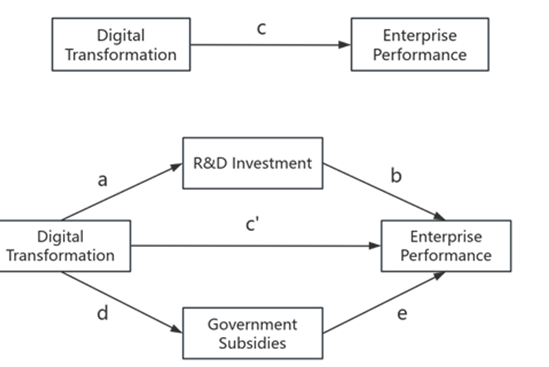
This paper comprehensively reviews existing literature, defining fundamental concepts such as digital transformation, R&D investment, government subsidies, and corporate performance. Based on relevant theoretical foundations, five hypotheses are formulated. Using a sample of Chinese A-share listed companies from 2013 to 2022, the study screens the samples through Excel, ultimately obtaining 29,433 valid observation samples. It empirically analyzes the impact of digital transformation on corporate performance, the influence of digital transformation on R&D investment, and the mediating effect of R&D investment and government subsidies.
The research findings are as follows: (1) Enterprise digital transformation has a significantly positive impact on corporate performance, and as the degree of digital transformation intensifies, corporate performance improves significantly; (2) Enterprise digital transformation can significantly increase R&D investment, and as the degree of digital transformation strengthens, R&D investment increases significantly; (3) R&D investment partially mediates the impact of digital transformation on corporate performance, and enterprise digital transformation can drive corporate performance growth by expanding R&D investment; (4) Government subsidies have a significant positive effect on digital transformation; (5) Government subsidies exhibit a significant negative correlation in the influence of digital transformation on corporate performance, demonstrating a negative mediating effect; (6) The nature of property rights influences the mediating effect of R&D investment. In the sample of private enterprises, R&D investment partially mediates the effect of digital transformation on corporate performance, whereas in the sample of state-owned enterprises, digital transformation does not play a mediating role. To facilitate the smooth digital transformation of enterprises, fully leverage the benefits of the digital economy for enterprises, and enhance corporate performance, this paper offers policy recommendations from both government and enterprise perspectives, ensuring their genuine contribution to promoting enterprise digital transformation and enhancing corporate performance.