
Optimization of Phase Change Thermal Storage Coupled PV/T Water Source Heat Pump Heating System
##plugins.themes.bootstrap3.article.sidebar##
##plugins.themes.bootstrap3.article.main##
Abstract
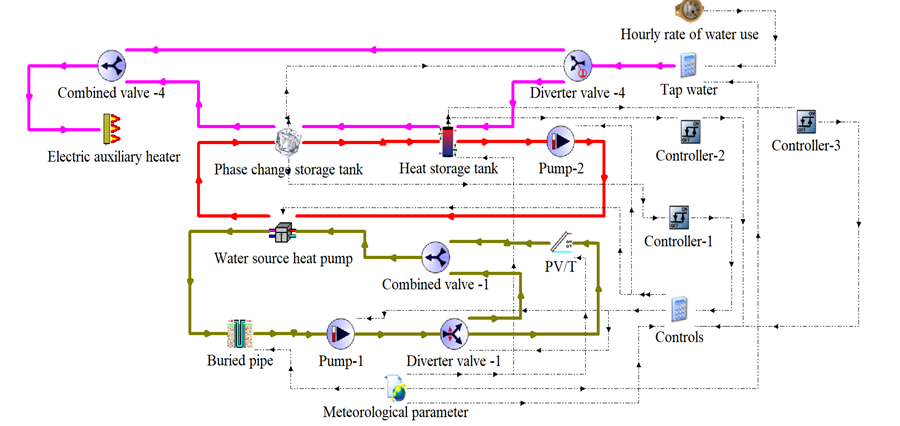
Aiming at the low-carbon transformation of China's heating system and the promotion of the rapid development of renewable energy, a set of low-carbon heating system coupled with phase-change thermal storage tank, solar photovoltaic photovoltaic solar thermal equipment and water-source heat pumps is designed, and a comparative analysis is carried out with the conventional solar geothermal energy combined heating system in terms of system performance. Using TRNSYS software to build a heating system model, with a dormitory in Xi'an City as the research object, the payback period and the system energy consumption coefficient as the objective function, and the key system equipment parameters such as the solar equipment area as the decision variables, the system was optimized using the NSGA-II algorithm for multi-objective optimization and the TOPSIS method to find the optimal solution. The optimization results show that the designed system has a shorter payback period and lower system energy consumption coefficient compared with the conventional solar geothermal energy combined heating system, and a comparative analysis of the optimal solutions searched for shows that the designed system can make better use of the low-grade energy sources and has a higher solar energy utilization efficiency.