
Investigating Subsidence Hazards and Water Accumulation in Non-Coal Mines using time-domain Electromagnetic Method
##plugins.themes.bootstrap3.article.sidebar##
##plugins.themes.bootstrap3.article.main##
Abstract
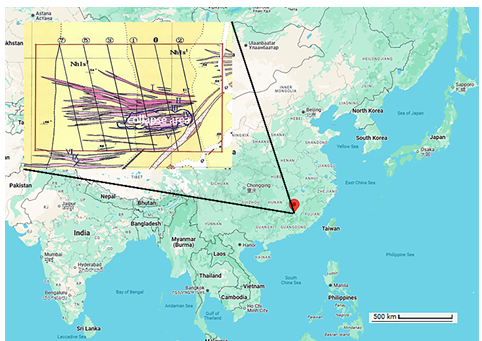
Underground voids caused by mining activities, particularly in non-coal mines, are significant sources of environmental hazards, including ground subsidence, fissures, and potential water accumulation. This study assesses the effectiveness of the Time-domain Electromagnetic Method (TEM) in detecting subsidence hazards and identifying water accumulation in non-coal mines, using a case study from a tungsten mine in southern China. Field measurements conducted at a detection depth of up to 200 m successfully identified subsidence areas characterized by resistivity values below 30 Ω·m, strongly suggesting the presence of water accumulation in these goaf areas. The results confirm that TEM is an effective tool for rapid, non-invasive detection of subsurface hazards in mining environments, with resistivity values below 30 Ω·m indicating potential water accumulation in goaf areas. The principles of TEM are introduced, and its effectiveness is demonstrated through case studies in a tungsten mine in southern China. The results demonstrate that TEM is a highly practical and effective tool for identifying subsidence zones and detecting water accumulation in non-coal mines, providing a rapid and non-invasive means for hazard detection and management, providing valuable insights for future hazard assessments.