
Decision-Making for the Digital Transformation and Sustainable Development of Artworks: A Game Theory Perspective
##plugins.themes.bootstrap3.article.sidebar##
##plugins.themes.bootstrap3.article.main##
Abstract
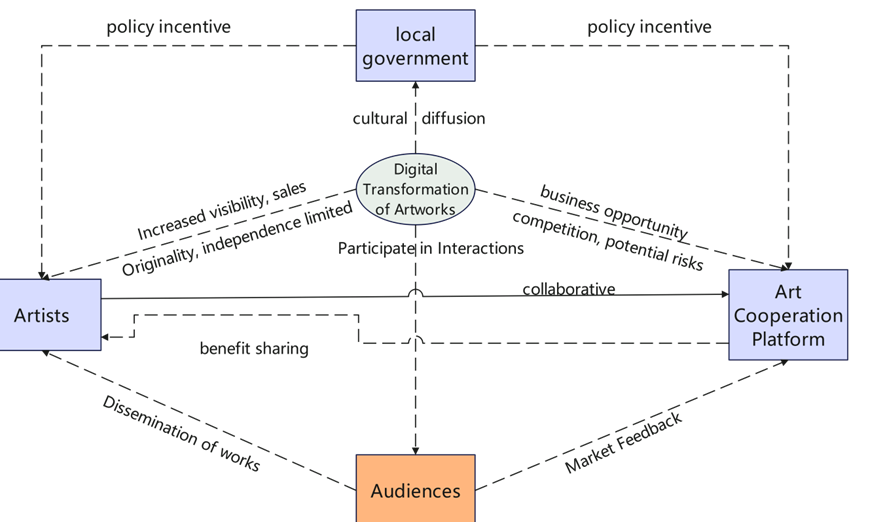
This paper explores the interaction mechanisms underlying the complex behaviors of participants involved in the digital transformation of artworks and provides recommendations for prioritizing the key factors influencing the sustainable development of such transformations. First, an evolutionary game model involving artists, local governments, and art cooperation platforms is constructed to analyze the benefits and costs for each party and to identify the evolutionary stable strategy. Second, the evolutionary game model and preliminary conclusions are validated through empirical analysis. Finally, the impact of critical factors on the evolutionary trajectory is discussed in detail. The results indicate that: (1) Initial willingness affects the speed at which equilibrium is reached, but does not alter participants' strategic choices. (2) Artists, as key executors in the digital transformation process, not only influence their own choices but also regulate the strategic choices of the government and art cooperation platforms. (3) Artists' strategic choices are influenced by the perceived loss of purity and originality of their works in supporting digital transformation, but not by incentives from art cooperation platforms. Meanwhile, the government's strategic choices are related to the amount of financial and human resources invested, as well as the penalties imposed on art cooperation platforms, which in turn base their strategic choices on the penalties imposed by the government.