
Differences in Volatile Organic Compounds (VOCs) Released by Fresh Syringa Flowers in the Frigid and Arid Regions of China Based on Metabolomics
##plugins.themes.bootstrap3.article.sidebar##
##plugins.themes.bootstrap3.article.main##
Abstract
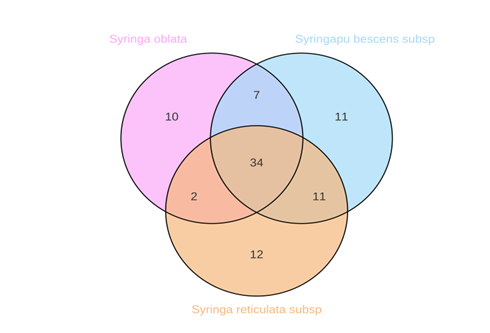
This study aimed to reveal the differential distribution of volatile organic compounds (VOCs) emitted by Syringa species under natural conditions in semi-arid regions. Dynamic headspace sampling coupled with gas chromatography-mass spectrometry (GC-MS) was used to collect and analyze the VOCs emitted by flowers of lilac oblata, Syringa pubescens subsp. microphylla, and Syringa reticulata subsp. amurensis. The results showed that the flowers of S. oblata, Syringa pubescens subsp., and Syringa reticulata subsp emitted 57, 60, and 55 VOCs, respectively, belonging to 8, 7, and 7 classes. Significant differences (P < 0.05) were observed in the types and relative contents of VOCs emitted by the three species. Orthogonal partial least squares-discriminant analysis (OPLS-DA) showed a prediction accuracy of 96.8% for distinguishing the VOCs emitted by the three species. Among the VOCs, 14, 8, and 16 compounds were upregulated in S. oblata, Syringa pubescens subsp., and Syringa reticulata subsp, respectively. The main components of VOCs emitted by S. oblata were 1-caryophyllene, ocimene, and linalool; those emitted by Syringa pubescens subsp. were δ-cadinene, heptadecane, and methyl benzoate; and those emitted by Syringa reticulata subsp were m-xylene, o-cymene, and thujopsene. These results provide a deeper understanding of the differences in the types and components of VOCs emitted by Syringa species in cold and arid regions of China, offering references for the rational configuration of landscape plants and the selection of potential health-beneficial tree species.