
Inflammation Mediates the Association between ABSI and Prostate-Specific Antigen : Results from the National Health and Nutrition Examination Survey
##plugins.themes.bootstrap3.article.sidebar##
##plugins.themes.bootstrap3.article.main##
Abstract
Background: Abdominal obesity, quantified by the body shape index (ABSI), has been implicated in prostate carcinogenesis, yet the mediating role of systemic inflammation remains underexplored. This study aimed to investigate the potential mediating effects of systemic immune-inflammatory biomarkers—the systemic immune-inflammation index (SII) and systemic inflammation response index (SIRI)—on the association between ABSI and total prostate-specific antigen (PSA) levels.
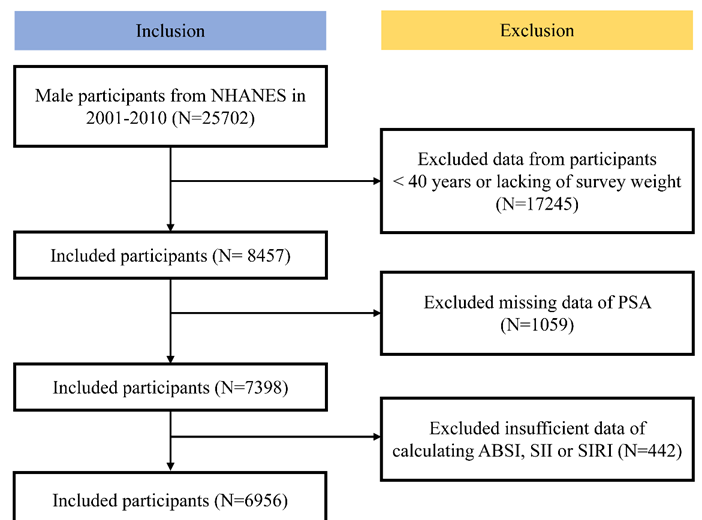
Methods: We used data from the National Health and Nutrition Examination Survey (NHANES) 2001--2010 and conducted a cross-sectional analysis of 6,956 male participants aged ≥ 40 years. The ABSI was calculated to assess abdominal obesity, whereas the SII and SIRI were derived from blood cell counts. Weighted linear regression and restricted cubic spline models were used to evaluate the associations between ABSI, inflammatory indices, and PSA. Mediation analysis quantified the indirect effects of the SII/SIRI on the ABSI-PSA relationship.
Results: A greater ABSI was associated with elevated total PSA concentrations (β = 0.34, 95% CI: 0.15–0.54, P < 0.001). The SII and SIRI were significantly positively correlated with the total PSA concentration (β = 0.28, 95% CI: 0.19, 0.36, P < 0.001; β = 0.25, 95% CI: 0.16, 0.34, P < 0.001). Mediation analysis revealed that the SII and SIRI accounted for 7.4% and 8.9% of the total effect between ABSI and total PSA concentration (P < 0.001). Subgroup analysis confirmed that covariates did not affect the association between ABSI and total PSA concentration (P interaction > 0.05).
Conclusion: Systemic inflammation, captured by the SII and SIRI, partially mediated the link between abdominal obesity (assessed via the ABSI) and elevated PSA levels. These findings highlight obesity-driven inflammation as a key mechanistic pathway underlying prostate-specific biomarker dysregulation, emphasizing the clinical utility of integrating ABSI with inflammatory indices for risk stratification. Targeted public health strategies focusing on reducing abdominal obesity and anti-inflammatory interventions could mitigate prostate cancer risk.