
Microbial Interventions for Reclamation of Saline-Alkali Soils: A Review of Community Dynamics, Soil Properties, and Restoration Mechanisms
##plugins.themes.bootstrap3.article.sidebar##
##plugins.themes.bootstrap3.article.main##
Abstract
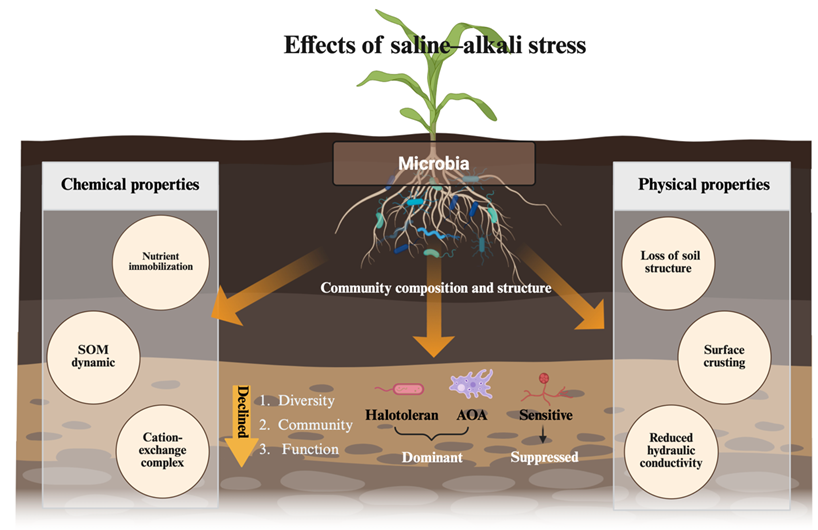
Saline-alkali soil degradation is a major global challenge to agricultural productivity and ecosystem sustainability. Excessive soluble salt content and high pH values of these soils cause severe soil and ionic stress on plants and soil biota, resulting in poor soil structure, inadequate nutrient cycling and diminished biological activity. Traditional remediation methods, including leaching and chemical amendments, are often costly, energy-intensive and unsustainable with adverse environmental impacts. Consequently, there is growing interest in using soil microorganisms to improve saline-alkali soils, which is an economical, effective and sustainable method. This review synthesizes current knowledge on the complex relationships between saline-alkali stress, soil physicochemical properties, and soil microbial community structure and function. It examines how salinity and alkalinity alter microbial diversity, biomass and community composition, selecting for stress-tolerant specialists such as halophilic and alkaliphilic bacteria. Mechanisms through which beneficial microorganisms, including plant growth promoting rhizosphere bacteria (PGPR), arbuscular mycorrhizal fungi (AMF), contribute to reclamation are detailed. These mechanisms include the production of exopolysaccharides (EPS) for soil aggregation, the synthesis of compatible solutes for soil regulation, the production of organic and biological acids for reducing pH, and the enhancement of nutrient availability. Furthermore, the review also explores the synergistic effects of microbial inoculants with organic amendments (e.g., biochar, compost) and plants within an integrated phytoremediation framework. Finally, challenges in translating laboratory findings into field-scale applications, such as inoculant survival, establishment, and ecological predictability, are discussed. Future research directions are highlighted, including the application of advanced omics techniques to uncover novel microbial functions and the design of targeted microbial communities tailored to specific saline-alkali soil conditions. We emphasize that strategic management of the soil microbiota is a fundamental component of efficient and ecologically sound restoration of saline-alkali lands.