
Research Progress of Bone Tissue Regeneration Scaffolds
##plugins.themes.bootstrap3.article.sidebar##
##plugins.themes.bootstrap3.article.main##
Abstract
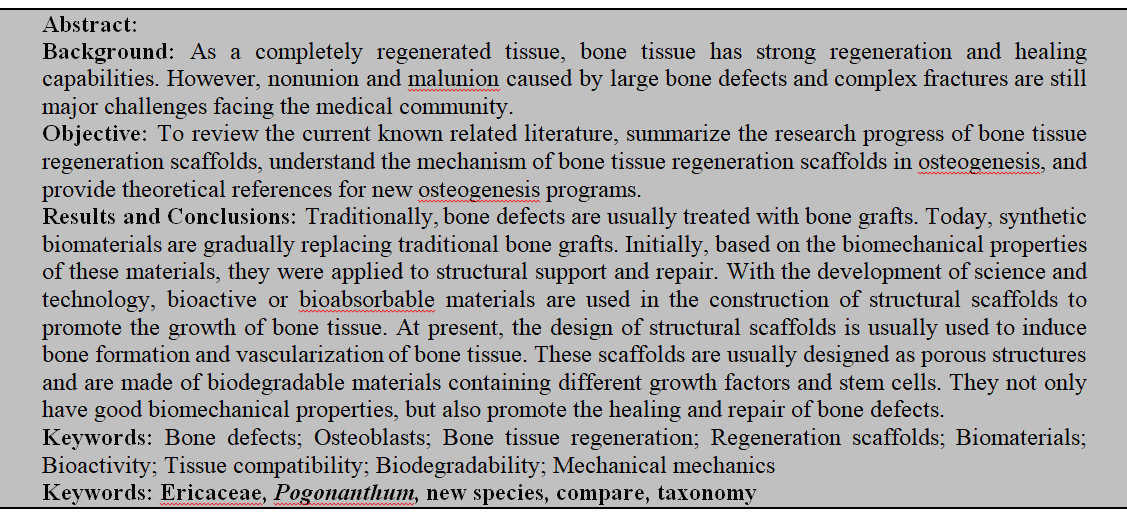
Background: As a completely regenerated tissue, bone tissue has strong regeneration and healing capabilities. However, nonunion and malunion caused by large bone defects and complex fractures are still major challenges facing the medical community. Objective: To review the current known related literature, summarize the research progress of bone tissue regeneration scaffolds, understand the mechanism of bone tissue regeneration scaffolds in osteogenesis, and provide theoretical references for new osteogenesis programs. Results and conclusions: Traditionally, bone defects are usually treated with bone grafts. Today, synthetic biomaterials are gradually replacing traditional bone grafts. Initially, based on the biomechanical properties of these materials, they were applied to structural support and repair. With the development of science and technology, bioactive or bioabsorbable materials are used in the construction of structural scaffolds to promote the growth of bone tissue. At present, the design of structural scaffolds is usually used to induce bone formation and vascularization of bone tissue. These scaffolds are usually designed as porous structures and are made of biodegradable materials containing different growth factors and stem cells. They not only have good biomechanical properties, but also promote the healing and repair of bone defects.