
Research on Brain-Machine Interface System Based on High-Frequency SSVEP Hand Rehabilitation Robot
##plugins.themes.bootstrap3.article.sidebar##
##plugins.themes.bootstrap3.article.main##
Abstract
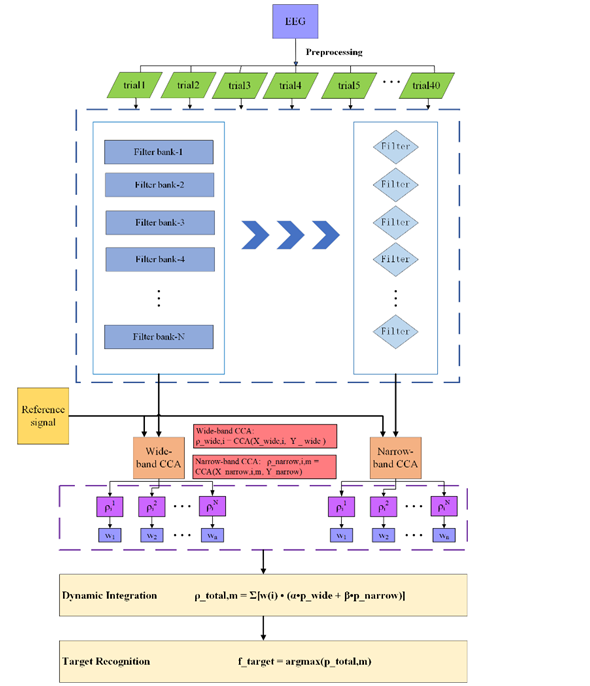
To address the limitations and poor comfort associated with traditional evoked-pattern paradigms in hand rehabilitation robots within the brain-computer interface field, a hybrid brain-computer interface system combining motor imagery (MI) and high-frequency steady-state visual evoked potentials (SSVEP) was employed. A four-category visual stimulator suitable for hand rehabilitation robots was designed. Comparative studies were conducted using different algorithms to analyze SSVEP and MI-SSVEP paradigms, collecting EEG signals from both paradigms under identical conditions. Using our self-collected dataset, we compared the proposed FB-NBPFCCA (Filter Bank Narrow Band-Pass Filtered CCA) algorithm with the Filter Bank Correlation Analysis (FBCCA) algorithm. Results indicate that the FB-NBPFCCA algorithm demonstrates superior performance in decoding action intentions under the MI-SSVEP paradigm, achieving a four-class gesture recognition accuracy of 95.5 ± 3.46% and an information transfer rate of 92.78 ± 5.65 bits/min.