
The ANLN as an Oncogenic Biomarker Associated with Immunosuppressive Microenvironment and Unfavorable Prognosis in Cervical Cancer
##plugins.themes.bootstrap3.article.sidebar##
##plugins.themes.bootstrap3.article.main##
Abstract
Background: Cervical cancer remains a significant global health burden with a poor prognosis for patients with advanced disease. Identifying novel prognostic biomarkers is crucial for improving patient outcomes. Anillin (ANLN), an actin-binding protein involved in cytokinesis, has been implicated as an oncogene in various solid tumors, but its role in cervical cancer is not well defined.
Methods: This study integrated bioinformatic analysis of public datasets (TCGA, GEO) with experimental validation using clinical samples and qRT-PCR/Western blot. The prognostic value of ANLN was assessed via Kaplan-Meier and Cox regression analyses. A predictive nomogram was constructed. Functional mechanisms were explored through gene enrichment analysis and a pan-cancer analysis of ANLN's expression and prognostic significance.
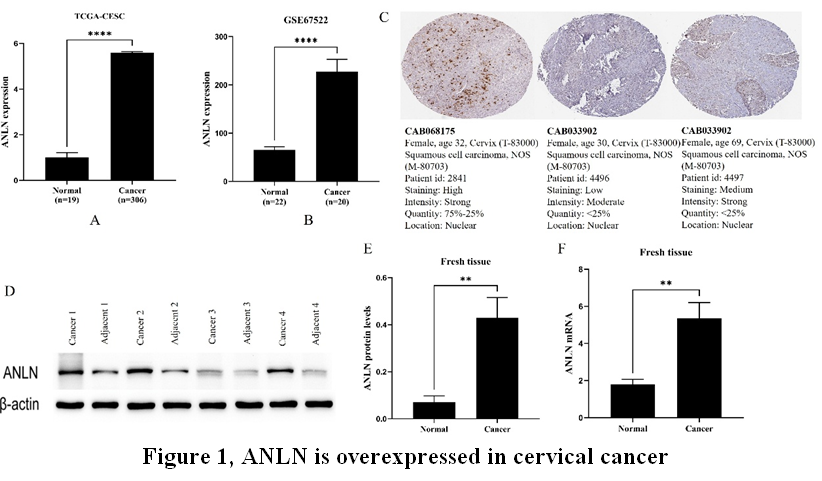
Results: ANLN was significantly overexpressed at both the mRNA and protein levels in cervical cancer tissues. High ANLN expression was an independent predictor of poor overall survival (HR(High) = 1.85, 95%CI: 1.15-2.90, p = 0.01) and was incorporated into an accurate prognostic nomogram (C-index: 0.70, p=1.85e-07). Bioinformatic analysis revealed that ANLN co-expressed genes were predominantly enriched in cell cycle-related pathways. Pan-cancer analysis confirmed ANLN's widespread overexpression and association with poor prognosis in multiple cancers.
Conclusion: ANLN is a potential oncogene and a powerful independent prognostic biomarker in cervical cancer, possibly through promoting cell cycle progression. It represents a promising target for prognostic stratification and the development of novel therapeutic strategies.