
Scutellarin Improves Insulin Resistance in Rat Skeletal Muscle Cell Lines
##plugins.themes.bootstrap3.article.sidebar##
##plugins.themes.bootstrap3.article.main##
Abstract
Background: Scutellarin (SCU), the primary active constituent of breviscapine, demonstrates a range of pharmacological properties, including anti-inflammatory, antioxidant, neuroprotective, and circulation-enhancing effects. Previous evidence indicates that SCU can ameliorate insulin resistance (IR). However, the underlying mechanisms through which SCU modulates IR in skeletal muscle cells remain incompletely elucidated.
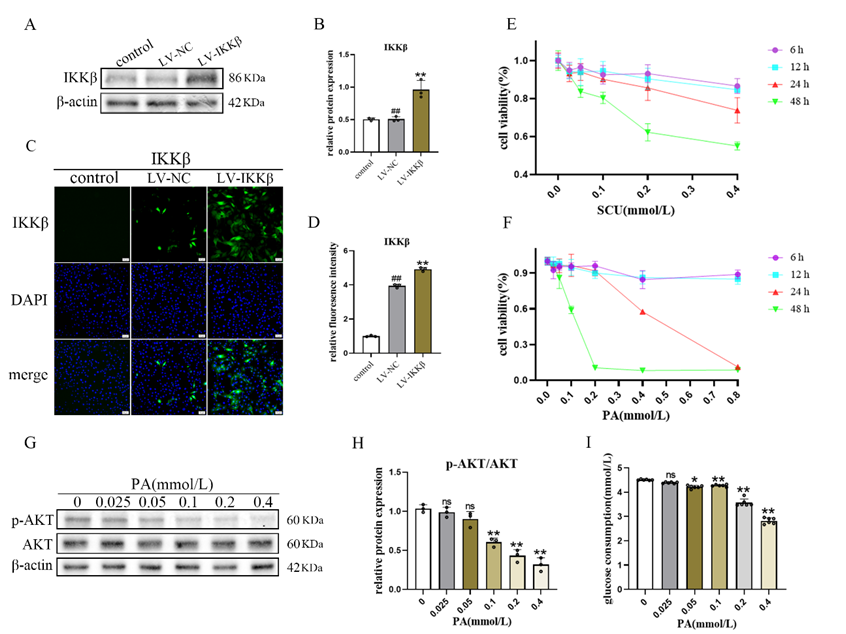
Methods: The efficiency of lentivirus-mediated IKKβ overexpression was evaluated via immunofluorescence (IF) and Western blot. Cell viability was assessed using the CCK-8. Glucose concentration in the culture medium was determined by the glucose oxidase method. Levels of tumor necrosis factor-α (TNF-α), interleukin-1 (IL-1), and interleukin-6 (IL-6) were quantified using ELISA. mRNA expression of IKKβ and NF-κB-p65 (p65) was detected by RT-qPCR, while protein expression of IKKβ, p65, and phosphorylated NF-κB-p65 (p-p65) was examined using IF and Western blot.
Results: Palmitic acid (PA) treatment successfully induced an IR model in L6 cells. Lentivirus-mediated overexpression of IKKβ, even in the absence of PA, triggered inflammatory responses and metabolic abnormalities resembling the IR phenotype, highlighting the critical role of IKKβ in IR pathogenesis. SCU intervention significantly suppressed the expression of TNF-α, IL-1, and IL-6. Concurrently, both protein and mRNA levels of IKKβ, as well as the phosphorylation level of p65, were markedly downregulated.
Conclusions: SCU inhibits IKKβ expression in skeletal muscle cells, reduces p65 phosphorylation, attenuates inflammatory responses, and consequently improves IR.